11 April 2021

Food Lab: Under Pressure

In at least one way, Chef Spouse and I have had an unusual pandemic experience: We haven't bought much stuff for the house. We already both worked from home full time prior to the pandemic, so we didn't need any office set up items, and we had the athleisure wardrobe thing covered. We redid our yard a few years ago - new porch, new patio, nice yard furniture, landscaping - and it's too small to ensure six foot spacing between groups, so we weren't part of the run on outdoor heaters and electric lap blankets in the fall.

We've been doing our damndest to keep a few small vineyards we love in business, buying every time an allocation is released (SO MANY BOXES OF WINE IN THE BASEMENT right now), but other than that, there just really wasn't anything much we needed to comfortably hibernate. 

Well, almost. 

One of our ongoing Food Lab jokes is "no uni-taskers!" (with much love to Alton Brown)

We have exceptions, of course, and we give each other unending shit about them (Mad Kitchen Scientist's rice cooker, Chef Spouse's asparagus pot, etc.). 

It's all part of the fun, along with jokes about ramekins, exploding shrubs, flying chocolate, cleaning lobster off the ceiling, Mad Kitchen Scientist and me not being allowed to shop unsupervised, and me laying on the floor with Mad Kitchen Scientist and The Executive Committee's dog after our second Food Lab moaning: "ATE. TOO. MUCH. STEAK."

At Christmas 2018, Mad Kitchen Scientist turned in his rice cooker in favor of an Instant Pot. Out: one uni-tasker. In: one Instant Pot convert.

Chef Spouse, who never met a decision he couldn't research to the nth degree, has been pondering getting one ever since. Yes, that means he's spent more than two years dithering over a device that costs about $75. 

So we finally decided to test it out.

There are many potential uses of an Instant Pot, but it's really best suited to pressure cooker or steamer type applications. Mad Kitchen Scientist has mostly used it for beans and grains (rice, oatmeal), and making homemade yogurt.

We decided to test it with beans, kidney beans to be precise.

One batch, we prepared the traditional way: Soak overnight, stovetop cook.


The other batch went into the Instant Pot, no prior prep required.


One of the advantages touted for the Instant Pot is that it's faster. In this case, it wasn't - the stovetop beans were ready first. Then again, we had done a FULL 12 hour soak, and stovetop didn't beat the Pot by much.

But the real question is: Which were better?

There, it was the Pot, by a nose. Slightly creamier, and definitely much more consistent texture. Which you can see in the photo below - the stovetop beans are on the right, the Pot beans are on the left.


The other thing, of course, is that we ALL do the thing of planning to have a bean dish for dinner, forgetting to start soaking the beans the night before, and then either bagging it in favor of carry out or eating at 10 pm because it took that long for the beans to soften in whatever the planned dish was. In that, the Instant Pot is the CLEAR winner.

Now that we had all these beans, what were we going to do with them? Red beans & rice of course! 

We cooked the rice in the Instant Pot, with no stovetop comparison.

Per Mad Kitchen Scientist, the big rice cookery advantage of the Pot is seen in brown rice that takes half a lifetime on the stovetop and about 30 minutes in the Pot (including time to come up to and off pressure). The other big advantage is that, like a rice cooker, it can hold cooked rice at temperature without getting gluey for an extended period of time. 

We also made some mango sticky rice for dessert.
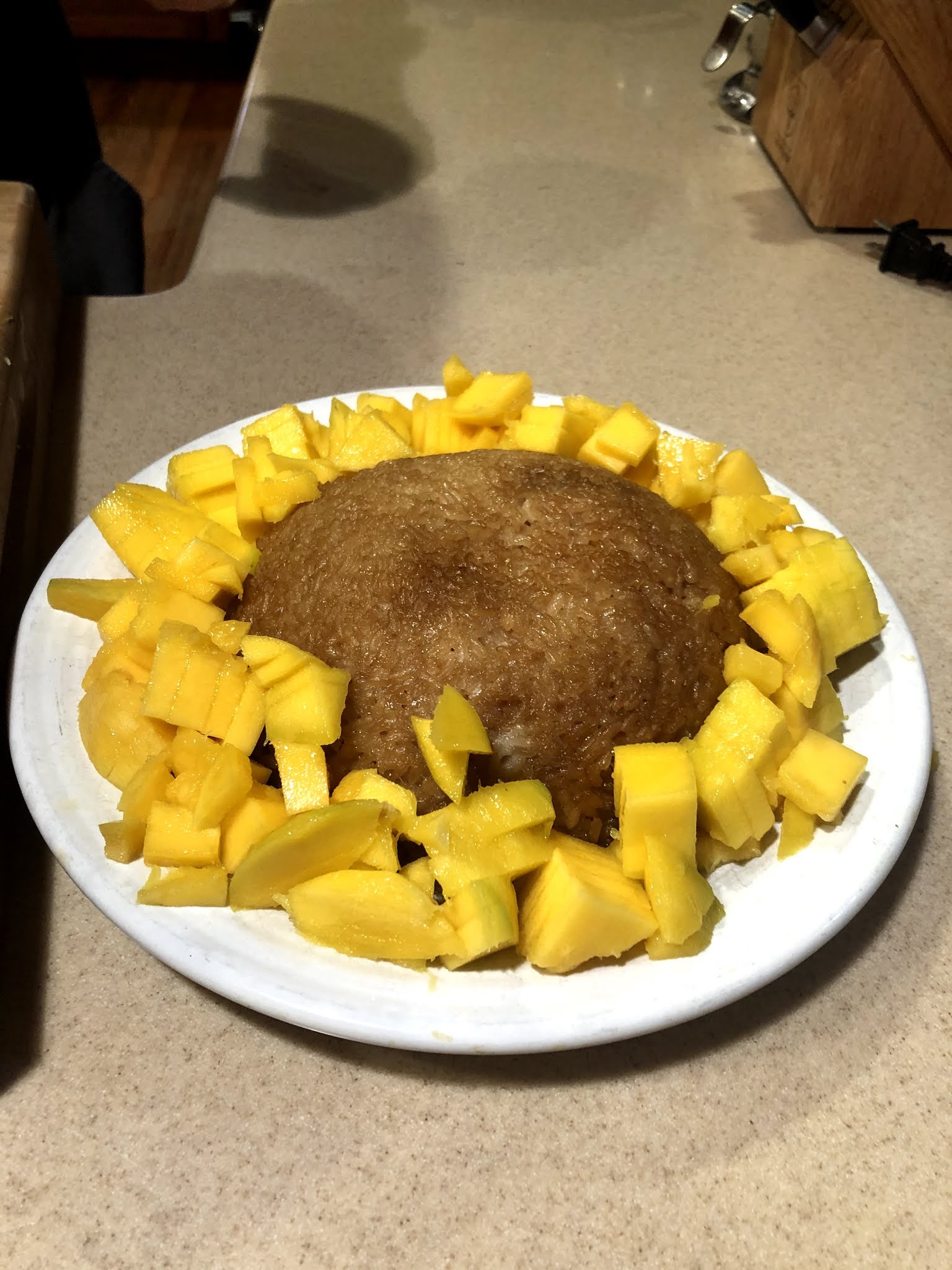

That is traditional sweet rice - the reason it's light brown is that we cooked it in coconut milk with a little palm sugar (rather than white sugar).

We had talked about Labbing stock making, stovetop versus traditional pressure cooker versus Instant Pot, but we quickly realized that was pointless: Why would one ever make only 3-4 quarts of stock? That's just silly.

Verdict? Pretty sure Chef Spouse is going to be getting an Instant Pot, as soon as he decides whether he's OK with a "regular" Instant Pot or if he wants to pay extra for this bad boy:


What about drinks? I had ordered something special for Chef Spouse a while ago that took some time to come in, but arrived just prior to our Lab and inspired our libations.

Let me preface this by saying there are a few kitchen tools I've been leery of getting. A mandoline and a kitchen torch top the list. Chef Spouse has had a mandoline for some time, and had cut himself, badly, on it. Never using it - always setting it up or cleaning it. Still, my caution was justified, and I'd sworn he was not getting a kitchen torch because I was afraid he'd burn the house down.

Call it pandemic insanity, but I broke my rule to buy him a drink smoker that was recommended by a friend of mine who's a licensed bartender and swears by this particular brand.  


I gotta say: a smoked whiskey drink is truly special - and delicious - and, as of yet, Chef Spouse has NOT burned down the house. Fingers crossed. 


30 January 2021

Food Lab: Celebration of America

We had another plan for a Food Lab for Saturday, January 23, but Mad Kitchen Scientist pointed out that it felt like it should be more of a celebratory thing, drawing from the heritage and background of our new President Joe Biden (Delaware, Ireland) and Vice President Kamala Harris (California, Jamaica, India).

We decided on the following menu:

Kerala hurricanes
Crab cakes with cilantro chutney and champagne
Fried plantains with mambo sauce (tostones because they weren't ripe enough to be maduros) 
Oxtail stew
Curried collard greens
Naan
California cabernet
"I cannot tell a lie" cherry pie
Irish whiskey

The table, decorated for Mardi Gras bien sur!

Although we didn't plan on it, we did end up doing a little labbing in the process.

The hurricane is a much-maligned drink, in part because too many people have only experienced it as red kool aid plus cheap rum. That is NOT a hurricane. A real hurricane is a sophisticated tiki drink that requires a variety of fresh juices, including passion fruit. What made it a "Kerala" hurricane? The addition of local DC Pratt Standard True Ginger Syrup, Kerala being the region of India where ginger was first grown commercially.


The crab cakes were a nod to Joe's Delaware roots. The key to a good crab cake is to have as little non-crab binder as possible. Chef Spouse generally goes with the minimum amount of panko bread crumbs and mayo that will allow him to form the cakes. Mad Kitchen Scientist had brought along some shrimp, which is another direction you can go: shrimp puree. We had a few extra, so we fried them up as a topper.


The plantains are a staple across the Caribbean, with the addition of Mambo sauce as a shout-out to Kamala's years at HU (You Know!). We ordered them from Baldor Foods, so of course the minimum 
order was 10 pounds. The only difference between tostones and maduros is the level of ripeness of the plantains, and with a 10 pound order, you would THINK that would be plenty for us to wait until some were completely ripe so we could try both kinds, and you'd be right, but we've had to intentionally restrain ourselves from frying up the last two. 


The oxtail stew was where we got into the labbing. Speaking of Baldor, that's also where we got the oxtails: 15 POUNDS of oxtails, and they did NOT come sectioned. Chef Spouse started with the cleaver, and quickly realized that was not going to cut it (see what I did there?). Fortunately, we remembered our Food Lab: Butchering lessons and immediately reached for the hack saw. 

Chef Spouse started with the Jamaican oxtail stew recipe from the NYT Cooking column, and it mostly worked well, although we did have a few notes. 

One, it takes MUCH longer than the three hours they list as a cooking time. Two, it should really be made over two days. On day one, take it up to the place in step five BEFORE you thicken the sauce. At that point, take it off the heat, remove the oxtails, let them cool, remove the meat from the bones, and chill the whole thing overnight. On day two, DEGREASE, reheat, and THEN make the water (or stock) based slurry to thicken the sauce. DO NOT DO IT AS A ROUX - which we did - because, trust me, it does not need any more fat added. 

Even day of, it was delicious - although greasy - and we were able to degrease some the next day before having the leftovers, although since we'd done a roux as a thickener, a lot of the fat did not separate to allow for degreasing. Oh, and it's DEFINITELY a "better the next day" type dish.


On the side, we had curried collards and naan (which was a throwback to our last lab), and accompanied the main meal with a lovely California cabernet. All of this, of course, in tribute to MADAM VICE PRESIDENT. 


Finally, in honor of a return to truth and accuracy to the White House (and to bad ass woman, White House press secretary Jen Psaki), a cherry pie made with a little Ginja cherry liqueur and MORE of the 40 pounds of sour cherries from our last Baldor order (there's a theme here) and a tot of a lovely gift from Mad Kitchen Scientist and The Executive Committee (which I think is also now the official house Irish whiskey) Writer's Tears.

Welcome, President Biden and Vice President Harris! You have NO idea how happy we are to see you! 

05 January 2021

Holidays and Some News!

Happy New Year, Foodies!

Now that our pandemic pod has met a few times, I think I can safely call it an unqualified success and, as we move into the annual darkest time of the year and what's likely to be the hardest time yet in the pandemic, a total sanity-saver.

Of course, the holidays are normally a time to gather with family and friends to feast and make merry. We normally spend Christmas Eve with a larger group of friends at the home of an Italian-American friend, and if you have any of those or grew up around them, you know what that means: Feast of the Seven Fishes. Then Chef Spouse makes a big meal - traditionally Julia's boeuf bourguignon - and we have some folks over on Christmas Day. Then we sometimes also gather with more friends to celebrate the British Boxing Day holiday with more yummy food and fellowship. The holiday week is then capped off with Mad Kitchen Scientist and The Executive Committee's annual New Year's Eve party, always imaginatively themed to organize the food and drink.

This year, none of that was happening. 

When we started chatting about this with our pod - MKS and TEC - we were like: "Seven Fishes, Boxing Day, or NYE?" We quickly realized AND was the key. 

Mad Kitchen Scientist was scheduled to be on call for his office on Christmas Eve and The Executive Committee had planned a virtual family cookie competition, so we pushed Seven Fishes to Christmas Day. And since it was only four of us, we decided to go fancy-schmancy. 


Fish 1: Osetra Caviar on MKS's blini with creme fraiche


Fish 2: Oysters on the half shell


Fish 3: Chef Spouse's fresh fettuccini with clams


Fish 4: Polpo with romesco sauce


Fish 5: Whole salt-baked snapper (pre-oven)


(post-oven)


Fish 6: caesar salad with white Spanish anchovies


Fish 7: timbales with MKS's home-smoked "bacon of the sea" (salmon)

We finished up with Italian cookies (chocolate almond biscotti, amaretti, anise pizzelles) and amaro in front of the fire.

For Boxing Day, Chef Spouse and Mad Kitchen Scientist decided they wanted to try making a beef wellington, seeing as we were celebrating a British holiday. Beef wellington, for those who haven't yet had the pleasure, is a full tenderloin slathered in yummy stuff, wrapped up in puff pastry, and baked until perfectly medium rare. It takes time to make because you have to allow the components to cool and firm up after each step. In short, they take a fair amount of time, but are, surprisingly, not that complicated to make. 

What yummy stuff? Recipes vary, but we went with mushroom duxelles, prosciutto, and foie gras (because we had some canned that another friend had brought back from a trip to Paris when that was still a thing one could do). You make the duxelles, tie up and sear the tenderloin, chill them both down, and then assemble. Roll out a sufficiently large rectangle of puff pastry to accommodate your tenderloin. Add a layer of prosciutto, making sure to leave a small clear space along one long edge for sealing. On top of that, layer your foie gras (should you be fortunate enough to have some), then your duxelles. Trim the strings off your tenderloin, place it in the middle, wrap up the whole delicious mass, seal it, then wrap TIGHTLY in plastic wrap and chill again. Bake until the meat registers 125 degrees. 

One tip on the baking: we had placed the wellington on a rack in the roasting pan so that the bottom wouldn't get soggy. That worked, but the puff pastry puffed through the rack, which made it a little challenging to remove. Next time? Parchment paper between the rack and the beef. 

How was it?


I think that picture is worth AT LEAST one thousand words.

New Year's Eve brought cioppino, champagne, cannoli (this time, we made a MUCH smaller batch), and Cards Against Humanity (which Rando Cardrissian nearly won, that bastard).


Had to include a picture of our NYE table just because

In other Food Lab news, you may have noticed that everyone referenced on this blog has a nickname, aside from me, your correspondent. After TEN YEARS, the rest of the Food Labbers finally noticed my trick, had talked amongst themselves, and planned to choose a name and name me on our ten year celebration trip to Paris and Provence this past fall.

Which did not happen.

So they decided to name me anyway. 

Many names were proposed, discussed, and discarded, until Mad Kitchen Scientist had the idea to check with Escoffier on kitchen positions. The team decided my role was somewhere between Chef de Brigade and Garde Manger in its more modern interpretation of one of ensures all parts of edibles are used. That morphed into Brigadier Manger, the one-star general who's on the field leading and organizing the troops. 

In sum: "Hi, I'm Brigadier Manger. Nice to meet you!" 


16 December 2020

Food Lab 47: Indian Breads


Your Food Labbers enjoyed a fantastic first pod/bubble meal together on Thanksgiving (cream of chestnut soup, Brussels sprouts salad with warm bacon hazelnut dressing, turkey with wild rice stuffing and gravy, Chef Spouse's decadent mashed potatoes, cranberry chutney, steamed green beans, sour cream dinner rolls, FOUR kinds of pie), and then gathered this past weekend for OUR FIRST FOOD LAB SINCE 2019.

Chef Spouse and I have been enjoying a fair amount of Indian cuisine during the pandemic, both due to cooking our way through the several Madhur Jaffrey cookbooks we have and due to the many excellent Indian carry out places walking distance from our house (one of which makes vindaloo so I hot I can't eat it all in one go - and that's saying something - and the other offering so many delicious vegetarian options, ordering without ordering WAY TOO MUCH is nearly impossible). And when we get take away, we always get bread - naan, roti, stuffed paratha - but when we cook at home? Not so much.

Well, that just cannot stand any longer.

We decided to tackle the three classics: roti, paratha, and naan. 

Roti and paratha are both unleavened breads that start with the same base - flour, water, a little salt (very similar to tortillas). The difference comes from the cooking method.

Naan is a leavened bread that generally also includes some animal fat/protein.

Seeing as the naan was going to have to rise, we started there. I had found various recipes that included egg, milk, or yogurt. However, Madhur Jaffrey's naan recipe included ALL THREE. Winner. 


Kneading the naan

The first challenge I ran into is that the dough was pretty dry. Jaffrey says to knead for ~10 minutes until smooth & satiny. I added about 1/4 c. additional milk as I went, but my dough never got "smooth & satiny" and by ten minutes in, it was developing a pretty firm gluten structure, so I figured I better stop and set it to rise and see what happened.

In the meantime, I moved onto mixing up my roti/paratha dough. Couldn't be more simple: two parts flour to one part water. Jaffrey did NOT have you include any salt, which we all felt might be a mistake (we were correct). 

Ah, but WHAT KIND of flour? 

Traditionally, folks use atta flour. We did not have atta flour, but the thing that makes it unique is that it has a high gluten content. King Arthur to the rescue! We decided to lab regular King Arthur whole wheat against King Arthur whole wheat pastry flour. Pasty flour, of course, is *pastry* flour because it has less gluten, so it stays soft and flaky rather than forming a firm structure. Yes, that's sort of counter to what you're ostensibly looking for in trying to make an unleavened bread, but we figured it would be an interesting test.

Anyway, you mix it up, knead it a bit, and then then it sit, covered with a damp towel, for ~30 minutes.


Roti/paratha dough in process

While that was resting, it was time to get ready to cook the naan. It's cooked a lot like pizza - set your rack about 6 inches from your broiler, pop your stones onto it, and then heat them as hot as your oven will go for a good 45+ minutes before baking.

Meanwhile, even though it never got smooth & satiny, the naan had doubled in size, so it was time to portion it, roll it out, and bake it. Three minutes on your HOT-HOT-HOT stones in your HOT-HOT-HOT oven so it puffs up, then turn on the broiler for ~30 seconds to brown it on top.


Patting out the naan dough


Portioning the naan dough


Rolling out the naan dough


Into the oven


Out of the oven

Easy-peasy, and it was DELICIOUS. It also held up the best the next day.

So why didn't the dough ever get "smooth & satiny"? I have a theory: Jaffrey calls for yogurt. I used the yogurt I normally have around - plain, whole milk Greek yogurt. Did you spot the problem? Greek yogurt is just regular yogurt....that's been strained again TO REMOVE EXTRA LIQUID. That straining that makes it so delightfully thick and creamy? Yeah, I think I maybe needed some of that to give the dough the right consistency. Next time, I'll start with more like 1 c. of milk to compensate, because once I was at the kneading stage, I was anxious about trying to add too much milk because I was afraid it wouldn't incorporate properly.

Onto roti and paratha! 

As I mentioned, the base is the same - the difference comes from how you cook it. 

Roti is just portioned out, rolled out, cooked on a hot comal or cast iron skillet, and then finished directly on the flame (gas stove or grill) to make it puff up. 


Roti puff from the whole wheat pastry flour


Roti puff from the plain whole wheat flour - now THAT's a puff!

Everyone else preferred the flavor of the pastry flour, but I like the regular whole wheat best - it was deliciously nutty, and you can't argue with that puff. Sadly, neither really held up the next day - the leftovers got fairly tough. Then again, it mixes up so fast and you can store the mixed up dough in the fridge (no worries about it over-rising because no leavening), so just cook what you're planning to eat right then. 

Paratha, on the other hand, is laminated first. Yes, like croissants. Only for paratha, you use ghee rather than cold (or even frozen) sheets of butter.

We found two methods of laminating. Jaffrey's was quite simple - roll out a disk, laminate with ghee, fold in half, laminate again, fold in half again (to give you a quarter), roll *lightly* one final time.


First lamination


Folding the dough


Second lamination


Folding the dough again and dusting with flour to roll out


Rolling out the dough 

Jaffrey's paratha then gets cooked immediately, in a cast iron skillet that's been brushed with ghee.


Cooking the paratha

Of course, while you're doing all that laminating is when you can slip in herbs or spices - the Indian carry out near us with all the amazing veg options does a masala spice paratha that is to die. We didn't mess around with flavors, but I plan to this coming weekend, when Chef Spouse and I will be making paratha again.

Serious Eats offered a more complex laminating method. You start with a much larger disk (basically two portions of your dough rather than just the one), roll it out thin again and laminate, but then roll it up like a carpet, stretch it, and roll the ends in like a palmier cookie. 


Rolling the laminated paratha up, carpet-style


Stretching the paratha


Aw - isn't that cute?

Then you rest ~45 minutes, roll out again, and cook, first dry frying on your comal and then finishing with a quick fry in ghee in your cast iron. 

Now remember, we had TWO versions of the dough: one with regular whole wheat flour and one with pastry flour.

I suspected we might be in trouble with the pastry flour when I couldn't stretch it and had to do a single coil as a result, and I was right. Pastry flour lacks the gluten structure to be able to sit at room temperature all buttered up and still be able to work.


The rolled out regular flour paratha cooking 
(and yes, it's OK to giggle - it 100% looks like a butt)


Pastry flour = Food Lab FAIL 
YAY!

Once we had all that bread, we needed something to eat it with, so Mad Kitchen Scientist and The Executive Committee whipped up some butter tofu and palak paneer for us, while Chef Spouse kept us occupied throughout the afternoon with various tamarind-based cocktails: a tequila version, a rum version, and a tiki-style drink that used the extra coconut milk from the butter tofu. No coconut milk left behind! 

They were all quite tasty, although Mad Kitchen Scientist observed, accurately, that they would be better served in opaque glasses, since the color was a little...odd. So we went with G&Ts for the meal. 


Your Food Labbers enjoying a yummy Indian feast

In conclusion, there is no reason not to make your own bread when you're making your own paneer or pindi or makhani. Naan requires a little thinking ahead - that rise takes about 60-90 minutes, so the whole thing start to finish is about 2-2.5 hours - but with roti or paratha, you could start the dough when you start work on the rest of the meal and have hot bread ready to go just as your main dish is finishing up. Chef Spouse and I will, in fact, be testing that theory this weekend.

Or, even shorter, homemade Indian meals will, henceforth, feature delicious Indian bread, too.


04 November 2020

Food Labbing in a Time of Coronavirus

Was April 2019 really the last time we had a food lab? Apparently it was, because the blog doesn't lie. Well, Mad Kitchen Scientist and The Executive Committee had a very busy summer, Chef Spouse and I did a ton of travel last fall (sigh.....), and then, of course, coronavirus hit. 

This has been an odd year for food lovers.

Weirdly, there have been some positive outcomes for those who care deeply about the quality and provenance of food. 

More people are cooking at home. More people are making things from scratch (hello, sourdough starter craze). More people planted vegetable gardens. More people signed up for CSAs (we resumed a CSA share, and I am SO PLEASED to report that I was able to find a local farm owned by a Black woman and operated by a team of women). Commercial suppliers enabled consumer accounts (well, they ALWAYS allowed anyone who wanted one to create an account - they just dramatically reduced the minimum order requirements, and more about that in a minute). 

It's also been a very hard time for food lovers. 

There have been shortages, both due to supply chain issues and due to panic buying. A woman in my larger circle, a long-time, serious baker, got savaged on social media for complaining that dilettante bakers were sucking up the entire flour supply. OK, sure, "flour privilege," but I also understood her frustration when MONTHS went by without being able to find flour of ANY type ANY where, when we all know significant amounts of it were sitting unused in the cabinets of people who moved on to learning French the following week and crocheting the week after and Peloton the week after that. 

Beloved restaurants and bars have struggled mightily. More casual places that always did significant carry out/delivery business mostly pivoted reasonably well and quickly, but the high-end places foodies dream of and plan for eating at had to radically and creatively re-tool their business models. And as cold weather closes in and the pandemic, which in the vast majority of the US was never successfully contained, ramps back up again, many of those beloved places will close, perhaps forever. That will throw a lot of people out of work and result in the hollowing out of a lot of business districts. 

Food related travel has ceased. And this was going to be a big year of that for your faithful Food Labbers. Chef Spouse and I were headed to Northern California once again in April, for a semi-regular conference speaking engagement I have, and this time we were were extending for a few days and heading to Napa because Chef Spouse had finally figured out the trick to landing a reservation at The French Laundry. He and I were also headed to Maui and the Big Island for a milestone birthday, with stays at a high-end eco resort, and in cottages on a coffee farm and a pineapple farm, with lots of diving (for him), snorkeling, kayaking, hiking, and, of course, eating planned. 

Most notably, 2020 marks ten years of Food Lab, and the core team - Chef Spouse and I, Mad Kitchen Scientist, and The Executive Committee - were headed to France for two weeks, with a week dining and sight-seeing our way through Paris (which I believe was to be a first for MKS and TEC), then a train hop to Avignon to pick up a rental car and another week at a gorgeous villa in Provence, repeating our Piedmont, Italy trip from a few years ago - farmer's markets, bistro lunches, hiking, and LOTS of cooking and wine drinking in the evenings. 

And the biggest hardship of all: one of the great joys of cooking seriously is sharing what you've created with people you love, and that's been right out for months. 

When DC passed into Phase 1 reopening in June, Chef Spouse and I were able to resume seeing friends in person - one household at a time and only one per week (to simplify contract tracing in case anyone did contract COVID-19), outdoors and physically distanced, and with everyone BYO everything. After three months of only interacting with other people via Zoom, it was a relief and major mental health boost.

During the past months, we've worked hard to incorporate some special food-related things, like ordering the most elaborate carry out dinner I've ever had for Chef Spouse's milestone birthday, figuring out how to get oysters direct from a local commercial oyster company, and setting up a consumer account with one of DC's top food purveyors.  At the time, there was literally no other way to find flour and there hadn't been for months. Thankfully, they allowed a minimum order of $250 (rather than the more typical $5,000). On the other hand, you're still mostly buying commercial quantities, so we split our 50 pound bag of King Arthur Sir Galahad with MKS and TEC (of course). We've continued to order from them for access to ingredients generally not available at the local Teeter (40 lb of pitted, frozen sour cherries? Why yes I will, thank you!) and to very high quality meats - and after butchering two entire lambs, breaking down an entire tenderloin of beef is really not a big deal.

But no Food Labbing, no parties, no dining out, no Supper Club (the  brain child of another friend of ours). Sadness. 

Well, that is about to change.

Health experts are recommending that people create small "pods" (or, as Chef Spouse prefers, "bubbles") to help us all safely get through the coming dark, cold months, when it will not be feasible to be together outdoors - at least not for very long - and when being locked in for months with just our own households just might make us all go crazy.  

Last weekend, as we were enjoying a lovely fall afternoon in Mad Kitchen Scientist and The Executive Committee's backyard and toasting "Next year in Paris!", we proposed creating a pod with them and, after consideration, they accepted. 

Our first indoor, no masks, shared meal since, I think, our Super Bowl party, will be Thanksgiving - we all liked the symbolism of that, and it will be more than two weeks past MKS and TEC's in person votes on Election Day (Chef Spouse and I voted early by mail) - after which....WE'LL BE RESUMING FOOD LAB!

So watch this space.....

24 April 2019

Food Lab 46: Onions (plus a guest star)

In spring, a young man's fancy may turn to thoughts of love, but your Food Labbers got thinking about onions. 

Alliums, and onions in particular, are one of the most common ingredients in savory foods of all kinds. Both Mad Kitchen Scientist and Chef Spouse have cutting boards dedicated just to alliums (because the last thing you want to do is cut up strawberries on a board that retains essence of garlic no matter how many times you wash it). Even if you're not sure what you're making for dinner, starting by mincing some garlic, dicing a shallot, or chopping up an onion is rarely going to be a waste of your time.

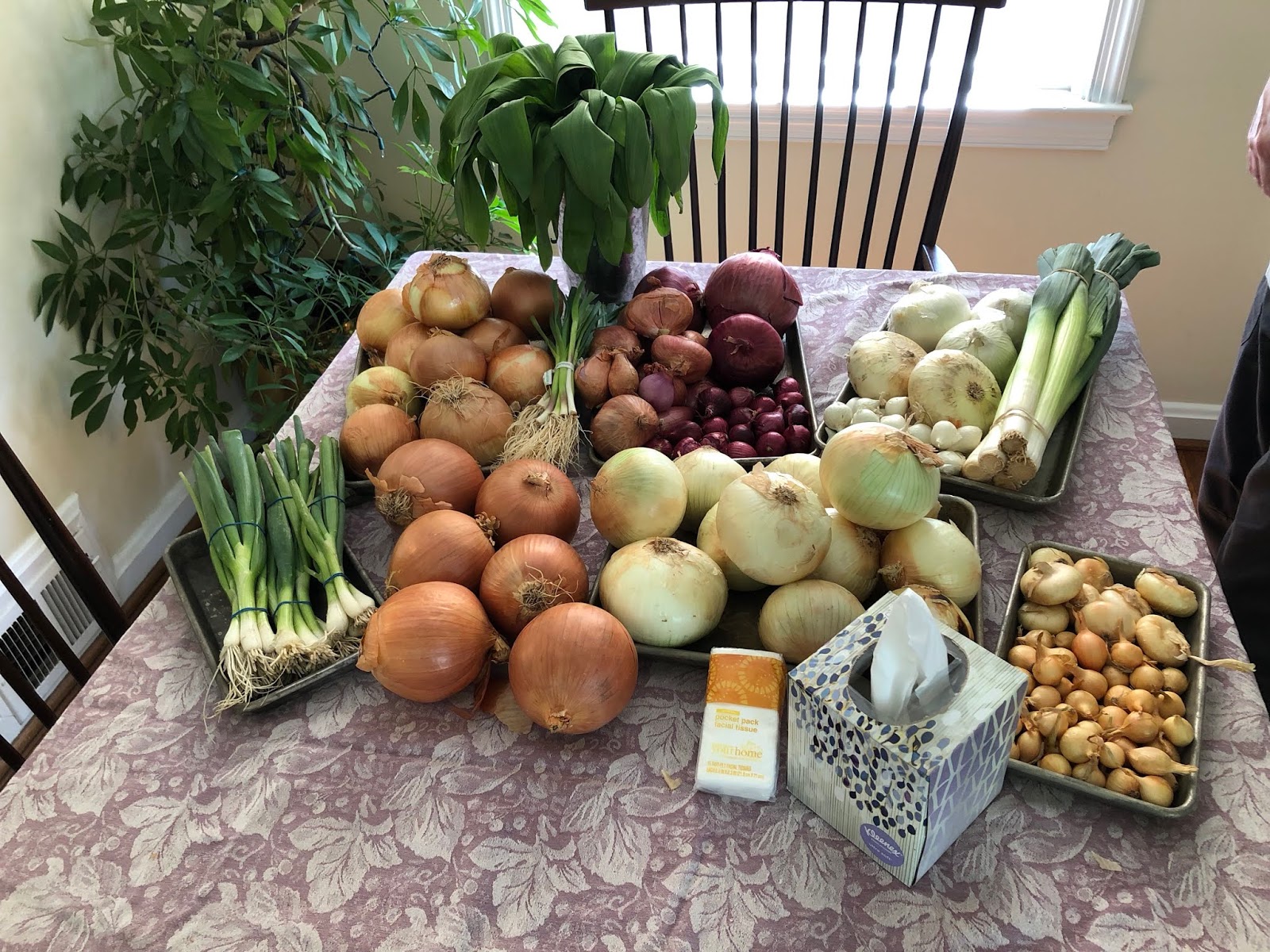
The thing is, we rarely pay much attention to our alliums. And there are so many varieties! Chives, garlic, scallions, spring onions, shallots, leeks, pearl onions, cipollini onions, white/yellow/red onions, sweet onions, Spanish onions, Vidalia onions, and of course, that elusive, delicious signifier of the season (and our special guest on Sunday) - ramps. 

Check out the tissues - we came prepared.
Sure, there are some rough associations: scallions as a finishing element, raw - shallots for French techniques and pan sauces - garlic that features prominently in Italian and Chinese cookery. But most of us just grab a string bag of onions and a bulb of garlic in our weekly run to the grocery store and figure we're good to go for another week's worth of dinners.

So we started with testing taste: Do they taste different? Yes, that meant tasting them all raw.

That's a LOT of raw onions, son. 
Short answer: they definitely all taste different, and the Food Lab crew highly recommends you do your own taste-off, preferably with a group that's also tasting with you, so you're not the only one with dragon breath at the end.

A few tasting notes:

Ramp tops are amazing - mildly peppery like really young arugula, but more more tender, and with a freshness that screams "SPRING!" If you get your hands on ramps in the spring, the temptation is to toss them with good olive oil, salt, and pepper and lightly grill them, and I won't judge you if you do. But you might want to consider - just consider - chopping the tops into a salad and then pickling the bulbs. 

Scallions really should never be cooked.

Cipollini onions are supposed to be sweeter than regular onions. That's a lie - at least with the ones we had. The zing on the palate was wasabi-level WHOA. I believe The Executive Committee may actually have been crying for a moment. 

If you're going for raw applications, you REALLY want to look for Vidalia or sweet onions. If you can't find them, red onions will work, but the Vidalia and sweet were definitely more mild and sweet, delightfully crunchy, and almost a bit creamy.

There wasn't as much difference in taste between pearl white, yellow, and red and regular sized white, yellow, and red as I would've imagined.

We then caramelized all the main varieties separately to see if they maintained their taste differences. 

Caramelization is about slowly cooking off all the water in the onions until they're a sweet and savory brown mass of umami goodness while also avoiding generating a Maillard Reaction. So low and slow, use cast iron, and salt early (remember, you're trying to cook all the water off). Also, set aside 45 minutes - one hour. No rushing! 

You cannot IMAGINE how good the kitchen smelled
One of the surprising differences was how much water the varieties contained. We started with precisely 565 g of each type, cooked in 2 TBSP butter, and identical amounts of salt. Most varieties, when the water was cooked off, ended up around 150 g. Not the Vidalia and the red onions though - they both ended up more like 250 g. Less water in the onion --> higher yield after caramelization. 

The sweet and Vidalia onions retained their distinctive creaminess and were more mild and subtle in flavor overall after caramelization. The rest of the varieties tasted pretty similar, other than the red onions, which were both strong and sweet and retained a little more structural integrity than the other varieties - see above, RE: less water. 

So once we had an absurdity of caramelized onions, then what? 

Caramelized onions freeze really well, in your handy-dandy ice cube trays, and we did plenty of that, for later use in any and all egg applications and grilled cheese and pan sauces and finishing soups. But we needed to make something we could eat - Food Labbers cannot live by raw onions alone (for which everyone else who knows or encounters us is deeply grateful).

We opted for galettes, which are basically pizzas that you make on pastry dough, or very rustic tarts. One variety was caramelized onions, Gruyere, green garlic and ramp leaves. The other was fig spread, caramelized onions, leeks, and blue cheese.


Of course, we grilled some ramps, and The Executive Committee made a lovely spring salad of radishes, snow peas, ramp tops, and ricotta salata (she is, after all, the one who makes sure we eat our veggies).

All this is pretty standard order. You know Mad Kitchen Scientist and I couldn't leave it at that. 

What's missing? 

Dessert. 

Oh yes we did make caramelized onion ice cream - vanilla custard base, the Vidalias, and toasted pecans. It was un-fucking-believable. So very, very good. This should definitely become a food trend, and if it does, make sure you point out that we discovered it first. 

Onion ice cream. It's a thing (or should be).
What did we drink? Gin, of course, first blind-tasting Bombay Sapphire, Hendricks, The Botanist, and the FEW barrel aged gins against each other in gibsons with home-pickled pearl onions (my favorite, and still the reigning champ, is Hendricks), then Chef Spouse used some saffron gin he'd picked up for me on a whim that has turned out to be VERY difficult to mix in a light cocktail featuring Cointreau, blanco vermouth, and orange bitters.

Our gin game is strong.
We did one other test, caramelizing onions in the Dutch oven on the Green Egg. As of 8 pm, when Chef Spouse and I had to get home to feed all our beasties, they were nowhere near done. I assume they finished in time for Mad Kitchen Scientist to go to work Monday, but I haven't confirmed yet. For all I know, he's still sitting there by the Green Egg watching the onions cook down and contemplating the universe. At least the weather's been delightful the past three days.