24 August 2015

Food Lab 32: Chorizo

No, I did not get the numbers out of order. As I'd mentioned in my last Food Lab post, we had made something that required aging. Well, the wait is over. We successfully dry aged sausage and didn't kill anyone!

Some of our out of town friends were visiting and wanted to see how sausage is made. Having successfully made sausage a few times, we decided to up the ante, with fresh Mexican chorizo and dried Spanish chorizo.

For the Mexican chorizo, we started with the recipe at honestcooking.com. What did we lab? The vinegar: cider versus white wine versus red wine versus sherry. Of course, Mexican chorizo is also intended to be fresh sausage style, so we didn't stuff it in casings. When we fried up the patties, we discovered that structural integrity was an issue (the pork shoulder we got from the McLean Organic Butcher may have been higher fat than the recipe stipulated).


You might think that the sherry would be the winner, and that's actually what The Executive Committee preferred, although the rest of us preferred red wine vinegar. We also pretty quickly realized that we needed to up the red pepper flakes. And we'd forgotten the garlic in the test batch. Oops! We corrected that in the full batches, which we made with red wine vinegar and a Tbsp of crushed red pepper flakes for each pound of meat.

But that wasn't the real test - the real test was making Spanish style chorizo. We started with the same base recipe, but divided the paprika between sweet and smoked, added cayenne, used sherry vinegar, and DOUBLED the salt.

And then we stuffed them.

And then Mad Kitchen Scientist and The Executive Committee hung them to cure in their basement for about two months. Yes, really. Raw meat.


When they were finally ready, we decided that we'd have to try eating them together. If we were going to go down to food poisoning and/or botulism, we were going as a group. So we gathered this weekend for an evening of eating raw meat we'd dry cured ourselves, making paella, and planning our upcoming foodie trip to Italy this fall (more about that in a future post).

The first thing we did was slice up one of the sausages and eat it. And we all survived! And it was DELICIOUS.

When none of us had dropped over dead immediately, we celebrated with white peach sangria, paella, and flan.

The sangria was very loosely based on this recipe, although I reduced the pineapple juice by about half, and the simple syrup by about 3/4. I was using berries and mango as the additional fruit, rather than apples and pears, and I thought it would be too sweet otherwise. And instead of goosing it with brandy, I used anjeo tequila. When I served it, I topped it with a little champagne, since I think white sangria benefits from bubbles.

The paella was loosely based on this recipe. We substituted chicken for the rabbit, mostly because we had a chicken and were too lazy to go over to Eastern Market for a rabbit. We didn't like the idea of using green beans, so we used some gorgeous red and green poblano peppers I had from the CSA, and we used far more than a "pinch" of saffron. It was also delicious, but it makes A LOT. We were each left with two quarter containers of paella leftovers. I know what I'll be having for lunch this week. The method is very similar to making risotto, which is logical when you think about it: force a lot of yummy liquid into a short grain rice, add tasty goodness in the form of meat and/or veg, and eat.

In keeping with the Spanish theme, we decided we needed to make some flan, too, based on this extremely simple recipe. Interestingly, they have you caramelize the sugar without any water. You have to go slow and keep an eye on it, but it got to a lovely dark brown color without any danger of burning, so I have to say that I recommend it. It didn't call for any salt, which I thought was bogus, so I added about a teaspoon. We baked in individual flan cups rather than one big pan, so we did the water bath method even though the recipe doesn't call for it, and cut the cook time back to about 40 minutes. It was probably about 5 minutes too long, or perhaps the specified temperature is a bit too high (Mad Kitchen Scientist said he's usually done flan at 300 rather than 350), so it was a little more firm that ideal, but still quite tasty.

I don't know that I would necessarily recommend attempting to dry age your own sausage to everyone. There is a very real risk of serious illness. If you're going to do it, make sure to use top quality meat, don't be shy with the spices or salt, and watch the sausages carefully as they dry. If anything feels, looks, or smells off, don't hesitate to dump them. That said, life is risk and this one was deliciously worth it.


03 August 2015

Food Lab 33: Thai

If it's the case that the motto of Cajun cooking is "first, you make a roux," (and it is), I would say that it's equally true that the motto of Thai cooking is "first, you make a paste."

This weekend, the Food Lab crew gathered for some experiments in Thai cooking. The idea was inspired by International Dilettante's international travels. Unfortunately, she and Dr. Fruit Bat were unable to join us (although they will be part of a fabulous trip to Villa San Lorenzo in the Piedmont region of Italy with us this fall).

In our previous experiments with regional cooking, we've discovered that, while the techniques may be unfamiliar, they're not generally complicated. The key, as our previous Rick Bayless / Diana Kennedy-inspired mole and Hana Market-inspired sushi labs have demonstrated, is quality ingredients. But where to find quality for Thai cooking in the DC area?

Fortunately, Mad Kitchen Scientist and The Executive Committee live in a suburban neighborhood with a large southeast Asian population, near the appropriately-named Grand Mart. We went a little crazy - as we tend to do - and walked out laden with bags full of delicious ingredients we then proceeded to spend all afternoon and part of the evening cooking at a shockingly low price.

This was more of a "cooking together" experiment than a lab per se. That is, we weren't taking a technique or ingredient and trying to perfect it. We were just trying to learn some of the mechanics of Thai cooking and make food that tasted good.

We were assisted in this endeavor by David Thompson's encyclopedic tome Thai Food, which Mad Kitchen Scientist received as a groomsman's gift from Dr. Fruit Bat many years ago. Seeing as it is a published and copyrighted book, I will not be sharing the specific details of the recipes we made, although if you are interested in Thai cuisine, I can highly recommend it.

As per usual, when we actually unpacked our haul, we realized we'd purchased too much. There was no way all that veg was going to fit into one curry! So Mad Kitchen Scientist quick stir-fried the lovely Chinese broccoli we'd picked up with some hoisin sauce, ginger, and garlic, for a snack while we planned our attack.

Course one: Thai cucumber salad
Course two: Green papaya salad
Course three: Pork satay
Course four: larb gai
Course five: veg green curry and steamed sticky rice
Course six: fresh coconut, fresh lychee nuts, sugar plums, jackfruit
Course seven: coconut milk ice cream


Chef Spouse and I have tried making the Thai cucumber salad before, and it's never turned out right. He thinks the problem is that we've been using white wine vinegar rather than rice vinegar (or ideally coconut - which we couldn't find at Grand Mart and appears to be something we'd have to make ourselves if we want it, and yes, Thai Food does have a recipe). I'd argue that it's because we've been going WAY too wimpy on the chiles. The long-leaf Thai coriander might make a difference, too, and using shallots rather than re onion. Regardless, this was DELICIOUS, even if Chef Spouse and The Executive Committee proclaimed it "too hot!"


The green papaya salad was my first "make a paste" dish, which is in fact what you start with. Mad Kitchen Scientist had already ground up all the ingredients for the green curry, but he cheated and used a mini food processor. I ground my damn paste with my damn mortar and pestle. He declared that I had more dedication. Damn right. One of the things that was interesting about Thompson's method for the green papaya salad is that he had you grind some snake beans and cherry tomatoes into the paste, and then combine it with the shredded green papaya and lightly mash it all together, with a liquid made of "tamarind water" and fish sauce. We couldn't quite figure out what "tamarind water" was, so we dissolved some tamarind paste in water. Seemed to work, and a gentle hand with the pestle turned out to be perfect for the mashing. Once again, delicious, authentic, and, for our two supertasters, "too hot!"


Why does anyone ever make satay with chicken? Seriously. My thoughts about chicken are well-known, but EVERYONE agreed with me. Once again, this was one of those "we've tried making this before and been disappointed at the results." Not this time. "First, you make a paste..." and the recipe made a ton of the peanut sauce/marinade, which we divvied up, so Chef Spouse and I plan to have MORE satay tonight.


I feel like the larb gai was our least successful dish. We finely chopped the chicken legs and thighs we used, but I think we should've gotten out the Kitchen Aid and the grinder. Following Thompson's recipe, it was delightfully sour (due to large quantities of lime juice and fish sauce), but not spicy at all. And I think the amount of toasted ground rice was too much - it thickened too much. I'd experiment with this again, but would want to tweak some of the processing and ingredients.


Even with the mild satay and larb gai, our spicephobics were asking for us to take it easy on the final course (the fact that they both kept eating the delicious but fairly spicy cucumber salad may be to blame). So we did, and went vegetarian too, to The Executive Committee's relief (she's always the voice of trying to be reasonable, not purchase too much, and eat something green. In other words, she's the adult in the room most times). This was another "first you make a paste..." activity, which was very simply combined with coconut milk to make the sauce that went over lightly stir-fried king oyster mushrooms, Thai eggplant, Chinese okra, baby corn, and steamed sticky rice.


The fruit was interesting. If you ever get the chance to have fresh lychee, take it. Choose pink/red ones that give slightly to a gentle squeeze. Peeling them is a breeze, and they're about a million times better than the ones in the cans - and the ones in the cans are pretty good. 

(We never ate that cute little yellow Chinese melon at the front - TOO FULL. The sugar plums taste like regular plums, but they're smaller, so you can just pop them in your mouth, and they have a slightly firmer texture, even though they tasted fully ripe.)

Jackfruit was an adventure. Freeing the edible part from the non-edible part is a bit of a challenge. This was the best explanation I was able to find:


And it is delicious - subtle, lovely flavor and interesting chewy texture. The one thing he neglects to mention is that it is INCREDIBLY sticky. The goo had to wear off my hands, and we had to get out Goo-B-Gone to get it off the handle of the knife.


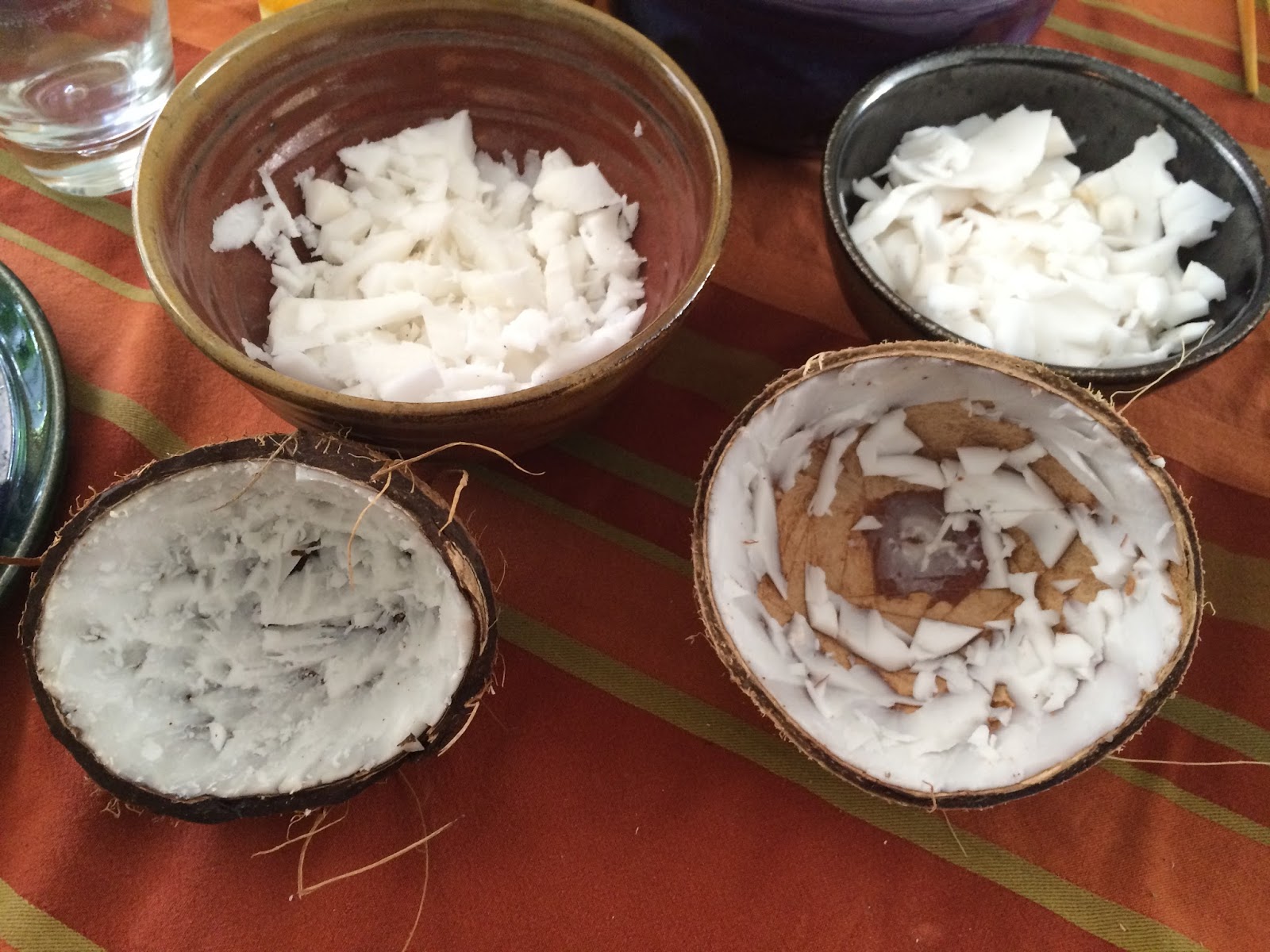
The Executive Committee was our coconut huller. She punctured green, young, and aged coconuts to get the coconut water (which we proceeded to use in cocktails) and then bashed the coconuts open with a rock (how Robinson Crusoe of her!) and cut out the flesh. The more "seasoned" the coconut, the tastier the flesh was, so if you're not just after the water, get the dark brown version that's your prototypical image of a coconut (the dude on the left above).

Speaking of coconut, we finished with a simple coconut milk-egg-palm sugar cooked custard ice cream. And more jackfruit.


On the cocktail front, we were playing around with lime juice, coconut water, and the tamarind in various applications. Nothing really jumped out at any of us, other than the fact that Thai basil makes an excellent addition to cocktails, and anything with tequila seems to benefit from the addition of a little salt. And sweet white wines go well with spicy food.

Verdict? Don't be afraid of cuisines that are outside your normal range of cooking. But make sure you visit a Grand Mart first.

(A note to the observant: food lab 32 *is* missing. That's because some of what we made required aging, and it's not done yet. So we'll be addressing that out of order and at a future date.)

08 December 2014

Food Lab 31: Mexi-Test

Your core Food Lab team has an annual swap agreement. The Executive Committee and Mad Kitchen Scientist throw a big annual New Year's Eve party, and Chef Spouse and I go over early in the day to help cook. Chef Spouse and I throw a big annual Super Bowl party, and The Executive Committee and Mad Kitchen Scientists come over early to help cook.

The Super Bowl party is always Tex-Mex because it seems appropriate, it's easy to make for a crowd that may include some vegetarians and/or gluten-free folks, and because Chef Spouse makes rockin' guacamole and fajitas.

The New Year's Eve soiree has a different food theme every yea, but the same requirements: finger food that can be served cold or at room temperature.

This year, Chef Spouse and I will be on vacation until the day before the Super Bowl, so The Executive Committee and Mad Kitchen Scientist have graciously agreed to do the shopping and day before prep work for our Super Bowl party. Given that, the theme for New Year's Eve seemed obvious: Mexican street food. Which we decided to pre-lab this weekend, rather than just jumping in with both feet and hoping for the best day of (I think our biggest risk ever was the sushi New Year's Eve, which happened WELL before our sushi lab this summer).

So for Food Lab: Mexi-test we chose a variety of dips in preparation for New Year's Eve and chiles rellenos and jalapeno poppers in prep for the Super Bowl. Chef Spouse had to miss due to work commitments, but fortunately we had two more hands in one of Mad Kitchen Scientist's colleagues and her spouse, blog nicknames pending.

We started with a Mexican cheese taste off:
  • Two types of Queso Blanco
  • Two types of Queso Fresca
  • Cuajada Casera (which is fermented)
  • Queso Seco (which is queso blanco with more water removed)
  • Two types of crema - Mexican, which was thinner and more subtly flavored, and Guatemalan, which was thicker and funkier


Conclusion: most of the flavors were pretty mild, but they were all VERY salty.

Our dip plans included:
  • queso with chorizo
  • pumpkin seed dip (from Diana Kennedy)
  • duck confit green chile 
  • haute seven-layer dip (which involved making guacamole, refried beans, two varieties of salsa, and two spiced cremas all from scratch)
The queso was simple. Pop two sausages out of their skins and brown in a cast iron skillet (that bit's key). Deglaze with a little tequila (flambe optional but recommended), then melt in a combo of queso fresca and blanco, and add a little turkey stock to help the fats from the chorizo and the cheeses emulsify. Simple and delicious.

The pumpkin seed dip (sikil pak) was a Diana Kennedy recipe.

1 cup unhulled raw pumpkin seeds
1/4 c hulled raw pumpkin seeds
1.5 tsp salt

Roast unhulled in a cast iron skillet until brown and toasty - add hulled and roast for one more minute, then coarse grind them and add the salt.


(Diana said all coarse grind, but on reflection, we thought it should've been half coarse, half fine - and 1.5 tsp. salt was a little too much)

Roast two whole tomatoes (skins, seeds, and all) and one jalapeno (same) under the broiler

Stick blend the tomatoes with1/3 - 2/3 c water

Fine chop the roasted jalapeno
Rough chop 2 Tbsp cilantro
Fine chop 2 Tbsp chives

Mix it all together and eat

We removed the jalapeno seeds post-roasting, and we probably should have left some in, because it could've been a little spicier, although it did get more spicy over time. But: delicious, and will definitely repeat for New Year's.

Duck confit green chile was an adaptation of a pork green chile Mad Kitchen Scientist usually makes.

In olive oil, saute:

3 cloves garlic, finely minced
3/4 a small onion, finely chopped
3 oz duck confit
1 tsp cumin seeds
two chopped jalapenos (one seeded and deveined, one whole)
1 1/2 chopped poblanos


Deglaze with brandy

Simmer w 3/4 c duck stock until the peppers are soft

Add some cilantro and stick blend

Then last 1/2 of poblano finely chopped, 1/4 small onion minced fine, 1 seeded and deveined jalapeno minced fine, 3 oz duck confit, two small chopped tomatillos and simmer until cooked through

It also ended up less spicy than ideal, but fortunately the Nicknames Pending had brought along homemade habanero pepper sauce, so we were able to jazz it up.

In prep for the seven-layer dip, Mad Kitchen made refried beans, The Executive Committee made guacamole, I made a simple salsa verde and pico de gallo, and Nicknames Pending made two varieties of crema, one based on regular sour cream the other on the Guatemalan crema.

Both had
  • Cayenne
  • Smoked paprika
  • Cumin
  • Coriander
  • Onion powder 
All to taste, and we tested chipotle with more cayenne versus ancho with less. I liked the hotter one (of course), and the ancho was notably more smoky.

Then we put two varieties together:

Refried beans
Spicy crema v. smoky crema
Lettuce
Guacamole
Pico de gallo v. salsa verde
Queso fresca
Chopped olives and green onions


Again, of course I preferred the spicy.

The only fail of the day was the poppers and rellenos. We labbed roasting the peppers first versus going raw. Some were filled with just a cheese mix (basically a combo of everything we had left), some were filled with the rest of the chorizo queso dip. Then we egg-washed, breaded with a combo of masa and flour, dried, and deep fried.

Basically all of them - roasted and raw - turned out too spicy for everyone, and the breading did not adhere AT ALL to the raw peppers. If we're going to do them for the Super Bowl, this is going to require at least one more test, but probably not for New Year's, because you really have to eat both of them hot.

What did we drink?

Duh. Margaritas.

Mad Kitchen Scientist had made a mango shrub with pineapple vinegar and palm sugar, so that featured prominently, as did the Herrandura reposado tequila and habanero sauce Nicknames Pending brought.

YUM!

10 November 2014

Food Lab 30: Chicken

In which the Food Lab Crew attempts to convince your humble correspondent that I am wrong.

I've long agreed with Anthony Bourdain on the subject of chicken: it's what people order when they don't know what they want.

Don't get me wrong. I have no objection to curry chicken stir fry, or Indian butter chicken, or a spicy, complex chicken mole. The thing is, those dishes are not about the chicken - the chicken is the blank slate protein on which the delicious sauce is crafted.

And don't even get me started on the current popular abomination that is the boneless, skinless chicken breast. That, to reference another of this weekend's activities, is definitely NOT "good eats," despite the fact that I spot so many in people's carts at the grocery store. What is wrong with you people?

So I am not really a chicken eater - pretty much EVERY other animal protein tastes SO much better, why would I bother?

Do you spot the problem?

No chicken = no chicken bones = no homemade chicken stock.

Now chicken stock, on the other hand, is incredibly useful as a soup base, for risotto, for pan sauces, for reheating items, or to boost the flavor of your rice or quinoa or barley. And while commercial chicken stock is not nearly as dreadful as, say, commercial beef stock (OH MY GOD NEVER EVER USE THAT FOR ANY REASON I AM NOT KIDDING), it definitely pales in comparison to a good, homemade chicken stock.

Also, pate. You need whole chickens to get the livers to make pate.

So Chef Spouse and The Executive Committee laid out the challenge: prove me wrong on chicken. No tricks, no ethnic spicing, no fancy sauces. Chicken that, pace Julia Child, tastes of the chicken and nothing else, and IS good eats.

So Chef Spouse procured five birds from the poultry guys at Eastern Market, and the Labbers, plus the Eggman and a VERY pregnant Die Künstlerwranglerin, assembled to make them good to eat.

But first! Pate!

As you may recall, we've already labbed pate, but Chef Spouse still has not been 100% satisfied with his. The taste has been fine, once we realized that simpler is better - a little allium, salt and pepper, cognac, a SMALL amount of juniper and/or allspice - but the texture has not been pleasing to him. Too dense/stiff. He decided that this weekend was the time to fix that. The key? Obvious and simple (but not easy): some heavy cream and a tamis. Adding heavy cream lightens up all that liver. Pressing all the pate through the tamis takes time and you do lose some product, but the difference in the texture is dramatic. Totally worth it.

OK, on to the chickens.

The Executive Committee had gone to the source - Mastering the Art of French Cooking - and chosen four methods for us: two oven (roasted and roasted casserole style in a Dutch oven) and two stove top (saute and fricassee). Since Chef Spouse had purchased FIVE chickens, we opted to add a brined, butterflied roast chicken to the mix.


The process for cooking chickens is relatively simple. You want to get your Maillard Reaction going, and you need some aromatics, and you need to baste. Which is pretty much what we did - the oven varieties got basted with butter and turned regularly, the fricassee followed Julia to the letter, and the saute got a nice even browning and then some quality time with some leeks, carrots, and celery.

There were several vaguely obscene moments, including comments about "bondage-ing" and the apropos arrival of Dinah Washington singing "I've Got You Under My Skin."

Bondage chicken

In the meantime, cocktails. This ended up being the summer of shrubs for us, so we decided to play around with various shrub-tails.

What is a shrub?

It's a Colonial era method of preserving fruit that involves the fruit, vinegar, and sugar. Shrubs have recently enjoyed a renaissance in cocktail culture, and the Washington Post food section did an article on them early this summer that proved to be excellent timing, as we made a large variety over the ensuing months to help us deal with the bounty of the CSA and the garden. They're excellent taken neat, as a base for a vinaigrette, with club soda, or, of course, in cocktails.

We've done several "fun with garden produce" evenings with the Food Labbers and Food Lab visitors over the past several months (all of which were good fun and good eating, but none of which amounted to a full lab) that featured various incarnations of shrub-tails, but this was the first time we included them as part of a full lab.

In the traditional 3-1-1/4 (or so) cocktail ratio, we experimented with:
  • Mad Kitchen Scientist's latest batch of kitchen gin - lemon bay shrub - limoncello
  • Silver tequila - pineapple/pineapple sage shrub - orange bitters
  • Mount Gay rum - pineapple/pineapple sage shrub - Angostura bitters
  • Vodka - Thai basil/ginger shrub - ginger liquer
  • Rye whiskey - Thai basil/ginger shrub - absinthe (dubbed The Shruberac)
  • Kitchen gin - pomegranate shrub - rhubarb bitters
We also did a 1-1 with the rye, orange/fennel shrub, and whiskey barrel bitters, and a 1-2-3 mix of amaretto, peach/ginger shrub, and Mouth Gay rum with a little Angostura bitters. (Hey, we had plenty of time while we waited for all the chickens to be done.)

And no, we didn't use all the shrubs we have - the cucumber, strawberry balsamic, cherry, mixed berry, and watermelon mint varieties never made it out of the fridge. Told you it was the summer of shrubs.

They were all quite good, although I must admit that I favored to two rye-based drinks, probably followed by the rum-based options. 

In the end, despite The Executive Committee's observation that "two delights make an epiphany," I remain unconvinced on the merits of chicken. All of the chicken varieties were totally edible and even tasty. The only one that was better than the decadent mashed potatoes Chef Spouse made to go on the side, however, was the saute:


And that was mostly due to the excellently crispy skin and the sauce.

Conclusion?

Chef Spouse made six quarts of really excellent chicken stock with the bones, trimmings, and veg slag, so he's happy.

And while I'll eat chicken if presented with it, Chef Spouse just needs to get in a regular cycle of buying bones (and containers of chicken livers) from the Eastern Market poultry guys like he does with the butcher and his veal bones. Because I'm never going to eat enough to keep up with the demand for stock around here when there's duck, pork, lamb, beef, fish, shellfish, game birds, venison, etc. in the world.


23 June 2014

Food Lab 29: Sushi

The inspiration for this Lab was the terrific reports I'd heard about a new Japanese market here in DC: Hana Market. I knew we had to make a field trip, and I figured we'd figure out what to do once we did. As we were all standing in the tiny, crowded dragon's cave of riches that constitutes Hana Market, oogling all the goodies and trying to not buy it all (which was made significantly easier by the fact that Chef Spouse and The Executive Committee had confiscated mine and Mad Kitchen Scientist's wallets, and no, I am not joking), it quickly became apparent: sushi!

After a brief detour to the Maine Avenue fish market, we returned home with this:

It's an absurdity of Japanese goodness!
We cracked into the Japanese snacks - sriracha peas, something we dubbed "Japanese Chex Mix" (only WAY more delicious), my very favorite salty seaweed snacks, seasoned baby octopus, and various delicately-flavored jellies - and started planning.

I should mention that we've made sushi before, the year our New Year's Eve theme was rolled items. The Executive Committee and Mad Kitchen Scientist traditionally throw a big New Year's Eve party, and Chef Spouse and I go over early in the day to help them prep. We usually have some sort of obscure theme, and that year, Chef Spouse and I cranked out a shitload of passable but far from transcendent veg maki. We clearly needed to make another run at this.

Step one: make sushi rice.

Step two: make dashi.

Step three: cut up all the gorgeous veg we bought: napa cabbage, daikon radish, green onions, cucumbers, avocado


Step four: cocktails! Chef Spouse came up with something we dubbed the Lychee Ricky-san

2 parts gin
1 part lychee juice  (drained from the canned lychees)
1 part simple syrup
1 part yuzu juice
1 lychee nut

Chef Spouse also played around with using a ponzu sauce we'd found (light in color and more citrus/vinegar than soy) in the drinks, but couldn't quite get the drink to balance.

I also prepped the lovely Japanese eggplants we'd purchased for this application to which I added some tofu and made with the dashi broth, not water and dashi bouillon (what do I look like, an amateur?), and, when I finished up the leftovers for lunch today, sriracha, because EVERYTHING is better with rooster sauce.


While we were waiting for the rice to cool so we could pour over the vinegar and sugar sauce, we decided we needed some miso soup. Mad Kitchen Scientist whipped up:

Our dashi broth
White miso
Steamed shrimp
Fresh tofu from the market
A little shredded napa, green onions, and daikon
A little soy sauce

Then, just before serving, each bowl got a quail egg cracked in. Yes, Hana had those too. Told you it was a dragon's cave of riches.


Thus fortified, we were ready to roll some sushi. We tried:
  • Yummy Teriyaki fish we found at the market (maybe sardines? unclear, but FULL of umami) and cucumber
  • Crab, avocado, and carrot
  • Salmon with shredded daikon we'd lightly pickled in the leftover octopus marinade
  • Shrimp, avocado, and matchstick daikon


We then took another brief break to enjoy the sushi and the lovely day. Lesson: it's hard to roll the sushi tightly enough for it to stay together without squashing it, although I definitely did better this time than that New Year's party.


We had also purchased two kinds of prepared wasabi, and a chunk of fresh wasabi root. Revelation #1: fresh wasabi is WORLDS better than the prepared stuff. No contest. It was amazing. It's pricey, but totally worth it if you can find it. The flavor is spicy rather than just hot, subtle and earthy. Wowza.


Then it was time to make nigiri. I formed the rice pillows, and Chef Spouse cut the fish (tuna, salmon, and halibut). Slicing it thinly enough proved to be a bit challenging. Mad Kitchen Scientist also opened some of the clams and slid them, raw, onto the rice pillows and dusted them with a little furikake.


One thing that Chef Spouse noted was that, while the fish we'd gotten was beautiful and fresh and looked and smelled great, somehow, the fish you get a good sushi joints seemed move flavorful. Damn restaurants. Bogarting all the best stuff.

 By this point, it was getting close to the start of the US/Portugal World Cup match, so we made a "festival" (Mad Kitchen Scientist's term) of sushi to eat while watching the match.


This lab was more about trying to improve technique than labbing per se, and I definitely feel more comfortable handling the sushi rice at this point, and Chef Spouse definitely got better at cutting the fish as he went. As Mad Kitchen Scientist observed, perhaps the most useful lesson to take away from this (other than the sheer awesomeness of Hana Market) is that the best way to learn a cuisine might be to find a market that's an authentic source, go buy a bunch of stuff, and commit yourself to working with those ingredients for at least a week, forcing you to think outside the (bento) box a bit.


01 June 2014

Easy Chocolate Truffles


Yesterday, we learned how to make truffles.

Don't get me wrong - Chef Spouse already knows how to make truffles.

He makes amazingly delicious truffles from a super-secret recipe that was given to him in STRICT confidence and with several conditions on the serving thereof for purposes of, and I quote: "sexual blackmail."

They rock.

They're also a bitch to make - time consuming, many ingredients, and quite finicky about precise temperatures and handling.

We were dining with our friend Chef Terry recently. He brought truffles for dessert, and he and Chef Spouse got chatting about making them. Turns out, Chef Terry knows an easier way. So we gathered yesterday for him to show us.

Chef Terry's truffles use precisely three ingredients:

220 g. of heavy cream
283 g. of 60% cacao Ghiradelli chocolate chips (plus more to enrobe your truffles)
About 1 Tbsp. of your flavoring agent (which in our case was amaretto)

Heat the heavy cream on the stove in a heavy bottomed sauce pan until it just starts to bubble, like so:


Remove it from the heat, pour your 283 g. of chocolate chips into a glass bowl, then pour over just enough of the warm cream to cover, thusly:


Let it sit for about 30 seconds to start the melting process, then whisk gently in one direction only and drizzle in the rest of the cream SLOWLY. All this "gently" and "slowly" business is to keep you from splattering melted chocolate and cream all over yourself and your kitchen. Unless, you know, that's your thing.

Then add your flavoring agent and whisk in. It should look like this when you're done:


"Hey!" you might say. "That looks just like ganache!" That's because it is. And at this point, if you happen to have a cake standing by and have changed you mind about making truffles, you can pour your ganache over your cake and be on your merry way.

Let's assume, though, that you want to continue your truffle adventure (or you have no un-iced cake handy). The next step is to cover your ganache tightly with plastic wrap and let it rest. Get the plastic wrap right down on the chocolate - you're trying to create an air-tight seal. Now comes the hard part: let the ganache rest at room temperature for at least 6 hours, preferably more like 24. The longer you wait, the easier the mixture will be to handle.

To form your truffles, you have two options: if you let the ganache rest more like 6 hours, you'll pipe them. If you let the ganache rest more like 24 hours, you'll scoop them.


Either way, you then want to let them set up for a few hours before enrobing them. You can shorten that by popping them in the fridge, but even then, they need at least an hour.

To enrobe, pour more of your 60% cacao chips into a glass bowl and microwave them for about 30 seconds. Stir gently, then hit them again for another 20 seconds or so. Stir gently, and test the temperature with an actual candy thermometer. You're aiming for about 101 degrees. You're tempering your chocolate (which Serious Eats explains really well, if you're curious). Short version: it's all about crystals. Once the chocolate is at the right temperature to do the right things to the crystalline structure of the cocoa butter in the chocolate, you'll be able to cover your truffles with a coating that will turn shiny and make them relatively shelf-stable.

The way you do it is pretty simple, but also kind of messy. You need chocolate on your hands, and then you drop the truffle center into the bowl, and gently toss it between your chocolate-covered hands to fully coat it. Wear gloves.


Then simply deposit them on your parchment-paper lined cookie sheet until the chocolate sets up and enjoy!

Oh - and all that "extra" chocolate that you drip onto the parchment paper in the process of doing this? Basis for your next batch of truffle centers.


07 April 2014

Food Lab 28: Pate

OK, it's not like Chef Spouse and The Mad Kitchen Scientist don't make pate regularly. In fact we recently had a discussion with some friends about what is the appropriate quantity of poultry to purchase in one go, to which we all replied: "Two (or three)." The reason? That gives you enough legs for confit, enough breasts for several dinners, bones for stock, and livers for pate.

But there's pate, and then there's PATE. The official Platonic form of pate, at least currently, is a truffle duck liver pate we get from the cranky cheese guy at Eastern Market. That was our model, our ideal, our goal to strive for.

We were joined by two new Food Labbers, the lovely couple who invited us to Thanksgiving in Catawba, Ohio, last fall: Dr. Fruit Bat and the International Dilettante. Who brought some delicious local apples and microgreens (had to have something to cut all that rich liver), and a shit-ton of really excellent wine.


Our base was:

1/2 lb. of livers (some duck, some chicken, some mixed)
1/2 c. diced shallots
1 1/2 tsp. minced garlic
1 bay leaf
1/4 tsp. pink peppercorns
1/8 tsp. white peppercorns
6 juniper berries
2 allspice berries

All sauteed in about 1 Tbsp. butter, then deglazed with either 1/4 c. cognac or 1/4 c. marsala. (That didn't really seem to make a major difference in the taste, though.)


We also labbed velvet-smooth, food processed then pressed through a Chinois, versus a more country-style, that was just food processed.

The smooth versions, one chicken and one duck, both with the marsala, were spiced with thyme, additional pink peppercorn, clove, caramelized onions, and then we tested salt versus anchovy paste. The clove was a little strong, and I think the anchovy paste was better, although I don't know if anyone else agrees. But the smoothness? Awesome. And a lot of work:


The chunky versions, one chicken and one duck, both with cognac, were spiced thusly. Version one had pink peppercorn, ground chipotle, ground brown mustard seeds, a little additional juniper, some Vietnamese cinnamon, and salt. Version two had fresh thyme, salt and pepper, caramelized onions, and truffle oil. Truffle oil is a DEFINITE yes. Wowza. Also, I tried using a food mill to get a smoother texture, which actually worked pretty well and was WAY less work.

We also had some duck/chicken mixed livers, and that's where we went a little crazy with the spicing:
  • Version one: parsley, chili powder, salt, caramelized onions, sriracha- YES
  • Version two: bacon, white and pink peppercorn, allspice, garlic, cloves, truffle oil, honey - eh
  • Version three: egg yolk, Calvados, Chinese five spice powder - O.M.G. YES!
Before you start on me, yes, I know there are no quantities. It's to taste, kids.

And yes, I am aware that we are already up to seven varieties of pate.


The Executive Committee also set us up with mushroom pates. Because her job is to remind us to eat our vegetables, and when I was a vegetarian in grad school years ago, one of my favorite dishes at one of my favorite restaurants in town was, in fact, mushroom pate. So we went two directions: Tres Mushroom and Walnut Pate and Hazelnut and Wild Mushroom Pate (NY Times recipe).

The Tres Mushrooms was an Executive Committee original, which she adapted specially for us:

1 cup toasted walnuts
1/2 cup minced shallots
1/2 cup unsalted butter
1/4 pound Shiitake mushrooms, chopped
1/4 pound Crimini mushrooms, chopped
1/4 pound Portobello mushrooms, chopped
1 Tablespoon chopped garlic
1/4 cup chopped fresh parsley
1 Tablespoon chopped fresh thyme
1/2 teaspoon salt
1/2 teaspoon white pepper
2 Tablespoons white wine
1 Tablespoon extra-virgin olive oil
1 Tablespoon Truffle oil

In a large sauté pan, melt ½ cup butter over medium heat and add shallots, cooking them until they are translucent. Add chopped mushrooms, garlic, parsley, thyme, salt, and pepper. Stir often. When mushrooms browned, add white wine. Continue to sauté until most of the liquid has evaporated.

Combine toasted walnuts, olive oil, and truffle oil in a blender or food processor until forms a paste. Add cooked mushrooms and blend to desired texture. Add extra salt to taste, mix again.

We left one alone, added chopped pistachios to one and chopped capers to another. CAPERS. YUM.

To quote The Executive Committee on the hazelnut and wild mushroom version:
It was good, but wild mushrooms got lost (had mix of dried morels, chantrelles, lobster, and porcinis reconstituted to comprise 3/4 pound, rest of "wild" filled out by adding extra fresh crimini). Recipe filled 3 ramekins, and we added cream to one, truffle oil to another and Chinese five spice to the third. The additions were tasty. Lessons on this recipe were that 1) reserve morels and chantrelles for fancy sauces where they will not be overwhelmed (duh), 2) fresh portobello in the "wild" mix could offer more meatiness, 3) might substitute olive oil and/or hazelnut oil for melted butter,and 4) make sure salt to taste.
And further:
Both mushroom pates had enough seductive umami flavor that they were easy to devour. Vegetarians will need to throw some elbows to get any.
She's not wrong.

If you're keeping track, that's an additional six varieties of pate.


Which makes thirteen all together. Which is lucky, of course, but also a LOT of pate. Good thing we had some veg, or we might've all keeled over immediately.

What did we drink? Lots of wine - I might've already mentioned that - and Fernet Me Nots, which The Mad Kitchen Scientist found for us, having Fernet and knowing my fondness for bitter drinks:

4 parts delish kitchen gin (that he and The Executive Committee had made special for Lab)
2 parts sweet vermouth
1 part Fernet Branca
Orange twist

It was OK, but with the addition of some Fee Brothers Aztec Chocolate bitters (and, in my case, also some Angostura), it was outstanding.


And I think that the bitterness really played well with the richness of the liver. Then again, I think bitter drinks go with pretty much everything, so I may not be 100% reliable on this.