07 April 2014

Food Lab 28: Pate

OK, it's not like Chef Spouse and The Mad Kitchen Scientist don't make pate regularly. In fact we recently had a discussion with some friends about what is the appropriate quantity of poultry to purchase in one go, to which we all replied: "Two (or three)." The reason? That gives you enough legs for confit, enough breasts for several dinners, bones for stock, and livers for pate.

But there's pate, and then there's PATE. The official Platonic form of pate, at least currently, is a truffle duck liver pate we get from the cranky cheese guy at Eastern Market. That was our model, our ideal, our goal to strive for.

We were joined by two new Food Labbers, the lovely couple who invited us to Thanksgiving in Catawba, Ohio, last fall: Dr. Fruit Bat and the International Dilettante. Who brought some delicious local apples and microgreens (had to have something to cut all that rich liver), and a shit-ton of really excellent wine.


Our base was:

1/2 lb. of livers (some duck, some chicken, some mixed)
1/2 c. diced shallots
1 1/2 tsp. minced garlic
1 bay leaf
1/4 tsp. pink peppercorns
1/8 tsp. white peppercorns
6 juniper berries
2 allspice berries

All sauteed in about 1 Tbsp. butter, then deglazed with either 1/4 c. cognac or 1/4 c. marsala. (That didn't really seem to make a major difference in the taste, though.)


We also labbed velvet-smooth, food processed then pressed through a Chinois, versus a more country-style, that was just food processed.

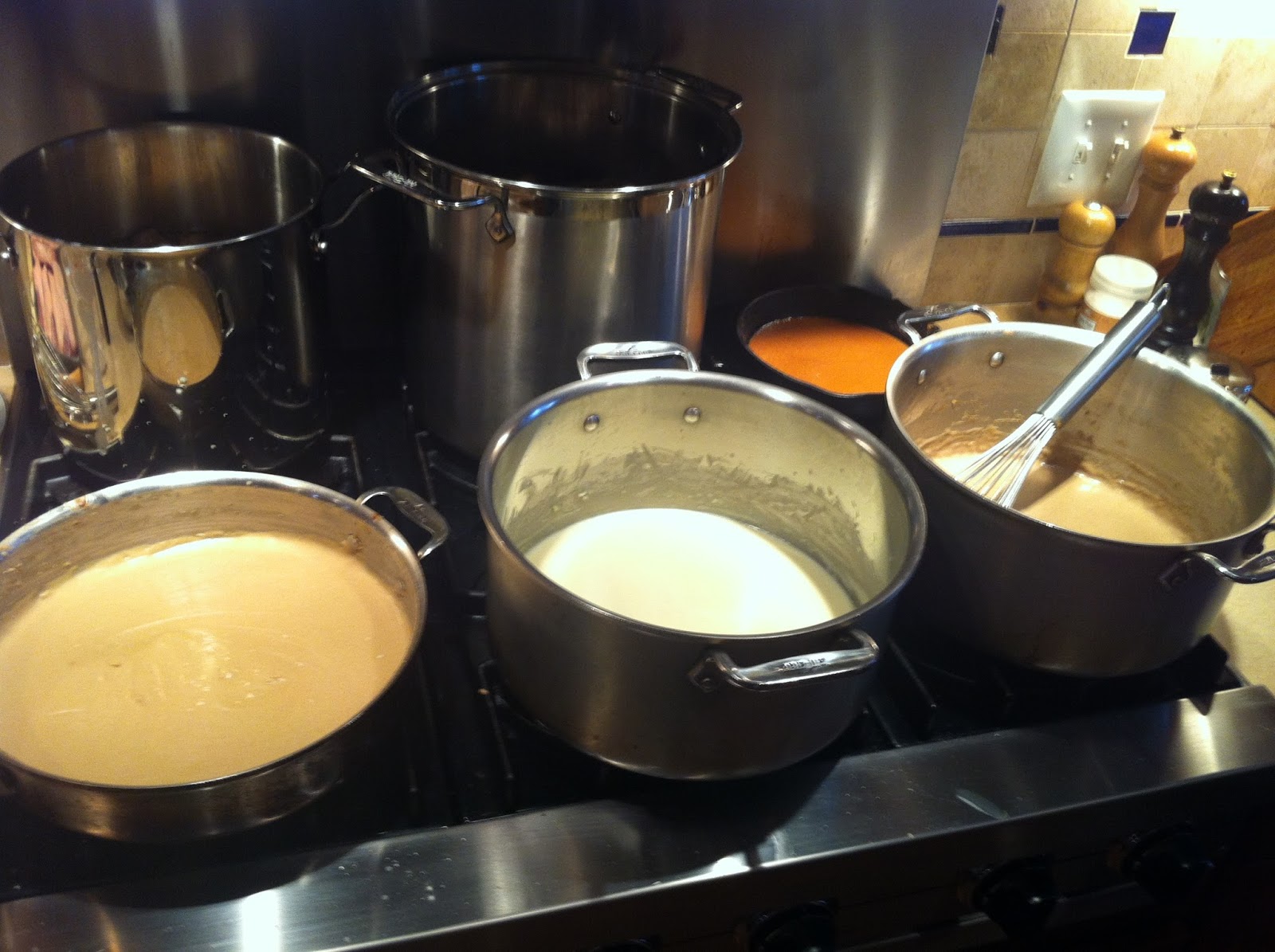
The smooth versions, one chicken and one duck, both with the marsala, were spiced with thyme, additional pink peppercorn, clove, caramelized onions, and then we tested salt versus anchovy paste. The clove was a little strong, and I think the anchovy paste was better, although I don't know if anyone else agrees. But the smoothness? Awesome. And a lot of work:


The chunky versions, one chicken and one duck, both with cognac, were spiced thusly. Version one had pink peppercorn, ground chipotle, ground brown mustard seeds, a little additional juniper, some Vietnamese cinnamon, and salt. Version two had fresh thyme, salt and pepper, caramelized onions, and truffle oil. Truffle oil is a DEFINITE yes. Wowza. Also, I tried using a food mill to get a smoother texture, which actually worked pretty well and was WAY less work.

We also had some duck/chicken mixed livers, and that's where we went a little crazy with the spicing:
  • Version one: parsley, chili powder, salt, caramelized onions, sriracha- YES
  • Version two: bacon, white and pink peppercorn, allspice, garlic, cloves, truffle oil, honey - eh
  • Version three: egg yolk, Calvados, Chinese five spice powder - O.M.G. YES!
Before you start on me, yes, I know there are no quantities. It's to taste, kids.

And yes, I am aware that we are already up to seven varieties of pate.


The Executive Committee also set us up with mushroom pates. Because her job is to remind us to eat our vegetables, and when I was a vegetarian in grad school years ago, one of my favorite dishes at one of my favorite restaurants in town was, in fact, mushroom pate. So we went two directions: Tres Mushroom and Walnut Pate and Hazelnut and Wild Mushroom Pate (NY Times recipe).

The Tres Mushrooms was an Executive Committee original, which she adapted specially for us:

1 cup toasted walnuts
1/2 cup minced shallots
1/2 cup unsalted butter
1/4 pound Shiitake mushrooms, chopped
1/4 pound Crimini mushrooms, chopped
1/4 pound Portobello mushrooms, chopped
1 Tablespoon chopped garlic
1/4 cup chopped fresh parsley
1 Tablespoon chopped fresh thyme
1/2 teaspoon salt
1/2 teaspoon white pepper
2 Tablespoons white wine
1 Tablespoon extra-virgin olive oil
1 Tablespoon Truffle oil

In a large sauté pan, melt ½ cup butter over medium heat and add shallots, cooking them until they are translucent. Add chopped mushrooms, garlic, parsley, thyme, salt, and pepper. Stir often. When mushrooms browned, add white wine. Continue to sauté until most of the liquid has evaporated.

Combine toasted walnuts, olive oil, and truffle oil in a blender or food processor until forms a paste. Add cooked mushrooms and blend to desired texture. Add extra salt to taste, mix again.

We left one alone, added chopped pistachios to one and chopped capers to another. CAPERS. YUM.

To quote The Executive Committee on the hazelnut and wild mushroom version:
It was good, but wild mushrooms got lost (had mix of dried morels, chantrelles, lobster, and porcinis reconstituted to comprise 3/4 pound, rest of "wild" filled out by adding extra fresh crimini). Recipe filled 3 ramekins, and we added cream to one, truffle oil to another and Chinese five spice to the third. The additions were tasty. Lessons on this recipe were that 1) reserve morels and chantrelles for fancy sauces where they will not be overwhelmed (duh), 2) fresh portobello in the "wild" mix could offer more meatiness, 3) might substitute olive oil and/or hazelnut oil for melted butter,and 4) make sure salt to taste.
And further:
Both mushroom pates had enough seductive umami flavor that they were easy to devour. Vegetarians will need to throw some elbows to get any.
She's not wrong.

If you're keeping track, that's an additional six varieties of pate.


Which makes thirteen all together. Which is lucky, of course, but also a LOT of pate. Good thing we had some veg, or we might've all keeled over immediately.

What did we drink? Lots of wine - I might've already mentioned that - and Fernet Me Nots, which The Mad Kitchen Scientist found for us, having Fernet and knowing my fondness for bitter drinks:

4 parts delish kitchen gin (that he and The Executive Committee had made special for Lab)
2 parts sweet vermouth
1 part Fernet Branca
Orange twist

It was OK, but with the addition of some Fee Brothers Aztec Chocolate bitters (and, in my case, also some Angostura), it was outstanding.


And I think that the bitterness really played well with the richness of the liver. Then again, I think bitter drinks go with pretty much everything, so I may not be 100% reliable on this. 

04 March 2014

Food Lab 27: Roux

Happy Fat Tuesday, y'all!

Your Food Labbers gathered on Sunday for our latest lab adventure. Mad Kitchen Scientist, the Executive Committee, Chef Spouse and I were joined by two new Labbers: Eggman and Die Künstlerwranglerin. With Mardi Gras right around the corner, we decided it was time to tackle something that's been on the "to lab" list for some time: roux.

Roux is a foundational technique of both French cooking and Cajun cooking. As the saying goes:


Roux is merely flour cooked in an equal amount of fat. It provides thickening to a variety of dishes ranging from the classic (espagnole sauce, béchamel sauce, and more on that later) to the down-home (gumbo).

Sounds simple.

Ah! But what flour? What fat? How dark? Fast or slow? And, perhaps the most important question one has to answer in order to make a real Cajun (dark) roux: what's the difference between burning and burnt?

We set out to answer all of those things.

We had a variety of fats to work with: butter, clarified butter, various vegetable oils, duck fat, bacon fat, lamb fat. We also had our standby King Arthur unbleached white all purpose flour, plus corn meal and pumpkin flour. And we wanted to work with fast and slow stovetop roux, as well as Alton Brown's oven roux technique.

Obviously, we were not going to make 12 varieties of gumbo, not least of which because you really need to wait until the next day to eat your gumbo, and that was not going to happen.

First Chef Spouse made us a round of his fantastic Ramos gin fizzes, to facilitate planning our order of operations. We decided that our first test would to make three roux on the stovetop, regular flour and butter, going light, caramel, and dark, and then turning those into béchamel to top roasted beets, roasted Belgian endives wrapped in proscuitto, and pearl onions sauteed in butter.


Eggman and The Executive Committee got to work processing the beets, endives, and onions. Mad Kitchen Scientist had also brought along three whole ducks (which is the quantity of ducks one buys when buying duck), so he and Die Künstlerwranglerin got to work disassembling them so we could confit the legs and make duck liver pate.

In the meantime, I was mid-way through making a King Cake. Die Künstlerwranglerin wanted to see how it's done, and I had started it earlier in the morning so it would be done in time for us to enjoy some later in the afternoon.

In that first round, we learned that it's pretty hard to make a dark roux with unclarified butter on the stovetop, as the milk solids tend to burn and get very bitter. Needless to say, the béchamel we tried to make with it did NOT taste good. Fortunately, I'd had the foresight to start a butter-based oven roux while everyone was busy chopping and whisking:


Also fortunately, we were left with completely serviceable caramel and light roux based béchamel for our onions, endives, and beets. Traditionally, béchamel is made with a very light roux, since it's a white sauce. Thing is, I've always thought that leaves it tasting of raw flour. Not appealing. If you're not concerned about maintaining that pure white color, our advice is to go for a caramel roux, with an egg yolk added at the end. That is some tasty, tasty béchamel, as we can attest, since we took a break to eat the béchamel-topped beets, onions, and proscuitto-wrapped endives.

Our next test was to look at other fats and other flours. We decided to make four dark roux: corn meal in bacon fat, pumpkin flour in duck fat, regular flour in duck fat, and regular flour in bacon fat. Whichever one(s) turned out would become étouffée later in the day.

Corn meal does not make a good roux. We're not sure if it's the lack of gluten, or the fact that it's coarser than flour, or what, but it ended up looking like the sand at the edge of the water at the beach, right at the tideline.

The pumpkin flour, on the other hand, was a very pleasant surprise. It made a really nice roux. So maybe it has nothing to do with the gluten content. Hmmm. We ended up combining it with the butter-based oven roux and using it as the base for duck confit and andouille étouffée that was the BOMB DIGGITY.

We also discovered that either duck or bacon fat make for a much better dark roux base, even if you're going slow on the stovetop, but particularly if you're using the fast roux technique.

What is the fast roux technique? Highest heat possible, and keep that flour moving at ALL times! If you're going to attempt the fast version of dark roux, you must roll your sleeves down and wear something like this on your hands. Cajun napalm is no joke if you get it on your skin, and the fast roux technique increases the chances that's going to happen dramatically.

The regular flour roux got combined for shrimp and andouille étouffée that was also quite good, but not as good as the duck confit version (quelle suprise!).

Chef Spouse usually makes étouffée with a relatively light roux, and I think the dark roux was a revelation. It doesn't offer as much thickening, of course, but I think it brings a lot more flavor to the party.


So what did we drink? In addition to the Ramos gin fizzes, we made sazeracs with various bitters, including The Eggman's gift for the house of Bitter Truth Creole bitters, which, as far as we can tell, were specifically made for sazeracs. Yep, *that* good. He had also brought some lavender honey simple syrup that we played with, too, as well as a small sample pack of unusual bitters, including chocolate and cardamon, which made their way into manhattans. Since we had a variety of absinthes, including a violently green Eastern European version The Eggman brought along with some Fee Brothers rock candy simple syrup, we also had to make an absinthe frappe.


The point of the absinthe frappe, a drink I happen to adore, is to get all the benefits of an absinthe fountain without actually having an absinthe fountain (or, if you have one, going through the trouble of setting it up and waiting). It's a shortcut to getting the absinthe diluted, sweetened, and cold. I endorse this technique.

Oh - and, of course, King Cake, beautifully decorated by The Executive Committee and Die Künstlerwranglerin.


Yeah, you right!

13 February 2014

Pretty Damn Good Chocolate Chip Cookies

About a month ago, my pops sent me a link to a recipe he found online promising the "perfect"
chocolate chip cookies.

And I made them, and they were good, don't get me wrong.

But this is Food Lab, goddamnit. "They were good" doesn't cut it. Drop and give me 20, soldier!

I thought the other cookies were too sweet. I liked going heavier on the brown sugar than the white for a nice moist cookie with a deeper flavor, but 1 1/2 c.  sugar total is too much, particularly with 12 oz. of semisweet chips AND 8 oz. bittersweet.

I also thought they were too large. In the "traditional" Toll House recipe, you're putting down about 1/4-1/2 oz. per cookie. "Perfect" tells you to make each cookie 2 oz. That's 1/4 c. batter. That's not a cookie - it's a dinner plate with chocolate chips in it.

I also followed the mixing directions to the letter, which was a mistake. I ended up with a bunch of unincorporated dry stuff at the bottom of the bowl. And kosher salt was a mistake, too - the grains are too big - and the recipe called for too little (also contributing to the "too sweet" problem).

So I decided to tweak the recipe.

1 c. unsalted butter at cool room temperature
2/3 c. brown sugar
1/2 c. white sugar
1 tsp. sea salt 
2 tsp. vanilla
2 large eggs
1 tsp. baking soda
2 c. flour
16 oz. (ish) of bittersweet chocolate chips (I didn't measure precisely - I had a full bag and a partial bag that was, I think, about 1/2 full, which would technically be 18 oz. of chips)
1 c. pecans, finely chopped (which you can replace with walnuts or skip entirely if you don't like nuts)

Preheat your oven to 375 F. 

Cream the butter, sugars, salt, and vanilla (you can do it by hand but it's a hell of a lot easier to do it in your stand mixer). The creamed mixture will not be as fluffy or light in color as normal because of the higher amount of brown sugar, but that's OK - don't worry!

Add the eggs and beat until they're fully incorporated, then add the baking soda.

With the mixer on low speed (so flour doesn't fly all over the place), add the flour 1/2 c. at a time, stopping to scrape up the bottom, scrape down the sides, and scrape out the paddle periodically. Mix until it's all fully incorporated.

Toss in your chips and nuts, and mix on low speed until fully incorporated. Make sure the arm of your mixer is locked, or all those chips and nuts will make it buck. Alternatively, you can take the batter off the mixer first and stir in the chips and nuts by hand.

Drop your cookie batter by rounded tablespoons onto your favorite cookie sheet. You're looking for about 1 oz. batter per cookie. It's up to you whether you grease or not, parchment paper or not, Silpat or not, or just go au naturel. I've tried it with the Silpat and bare and not noticed a significant difference.

Bake for about 9 minutes. The original recipe is correct - you need to pull them out when they're getting a little brown and crispy at the edges but are still underdone in the middle. Let them rest on the hot cookie sheet for about a minute to firm up, then remove them to racks to cool.


Tell me those aren't gorgeous!

Next time, I think I'm going to try forming them into balls and refrigerating them before baking, like I do with most of my other butter-based cookies. I think it will help them maintain their shape better in the oven.

28 January 2014

Food Lab 26: Mole

Every year for our Super Bowl party, Chef Spouse creates a Tex-Mex extravaganza (with the assistance of Made Kitchen Scientist, The Executive Committee, and me). Every year for the past few years, the Tex-Mex extravaganza has been getting more complex. We now make all our own tortillas (corn and flour of course) to wrap around Chef Spouse's delicious fajita fillings and homemade guacamole. We are likely to add homemade salsa this year, too, and we have talked about doing all the tortilla chips from scratch, since we have a deep fryer.

While we were prepping this year's New Year's Eve feast, we were chatting with MKS and TEC about what might add to the Super Bowl deliciousness, and we arrived on mole. Mad Kitchen Scientist has made mole before, but Chef Spouse and I have not. Hence, a Food Lab.

MKS posited that, if we were going to do this right, we would have to start the Lab with a field trip to the legendary Penzey's Spices, since we were going to need a wide variety of dried chiles and interesting spices. To date, Chef Spouse and I have been, well, resistant is not really the word. Slow to get on the Penzey's train, mostly out of fear for our bank account. Turns out, that fear was well founded. We got chiles, for sure, but Chef Spouse and I also dropped over $100 on


In case you can't see it all, that basket contains:
  • Star anise
  • Crystalized ginger bits (pre-chopped to perfect baking size)
  • Red chile flakes
  • Brown mustard seeds (Chef Spouse has been doing a lot of Indian cooking lately and could only find yellow at the local megamart)
  • Juniper berries
  • Vietnamese cinnamon (SOOOO spicy!)
  • Chinese cinnamon (sweet, rich, and warm)
  • Galangal (for Thai cooking, and also hard to find at the local megamart)
  • Cumin seed (NOT ground, also useful in Indian food and hard to find)
  • Green cardamon seeds (GORGEOUS and impossible to pass up)
  • Ceylon whole cloves (bright and fresh)
  • Madagascar whole cloves(darker and richer)
  • Smoked paprika
  • Sumac
  • a GIANT bottle of high quality Mexican vanilla extract (hey, it's not like it goes bad)
It was a bit of a frenzy, and required reorganization of our spice storage when we got home.

Then, when we got back to Chez Executive Committee, Chef Spouse played with Mad Kitchen Scientist's new toy from Santa. We already have four different knife sharpening tools/systems, and we live less than one mile from a butcher who can professionally sharpen your knives in 24 hours or less for, like, $3 a knife. But apparently, we need another knife sharpening tool in the house. Of course, Chef Spouse is going to have to get the fancier, more expensive kind because he has both German and Japanese knives, which sharpen at different angles. Sigh.

We also parboiled five pounds of chicken thighs so we'd have something to eat all this mole on (and which provided a few quarts of a very light chicken broth that turned out to be quite helpful).

Anyway, we eventually started work on the mole, guided by MKS's house recipe, Rick Bayless, and Diana Kennedy (who, if you weren't already aware, apparently hate each other, which led to much trash talking about "team Bayless" and "team Kennedy").

I quote Rick on mole (thus revealing my team preference):
...when you say mole poblano, non-natives immediately think "chocolate chicken," while natives' mouths water to visions of a dark, complex sauce made of dried chiles, nuts, seeds, flavorings, vegetables, spices, and, yes, a bit of chocolate. 
Whereas Diana Kennedy insists that mole does NOT include chocolate.

From what we could determine, basic mole consists of chiles, nuts, allium, some sort of fat (traditionally lard), spices, and a binder (generally stale tortillas). It may, but does not have to, include fruit, tomatoes, and/or chocolate.

So after some debate and comparing of recipes, we decided to lab four varieties:
  • Dried chiles, no chocolate
  • Dried chiles with 2 TBP cocoa powder
  • Dried chiles with 2 oz. chopped 60% cacao bar chocolate
  • Fresh chiles only, which also got 2 oz. of the bar chocolate
For each of the three dried chile varieties, we used:
  • A little more than 1 chipotle (which are jalapenos that have been allowed to ripen to red before being dried, and were the hottest of the four)
  • 5 cascabels (sweet and vegetal)
  • 8 guajillos (smoky and mild)
  • 3-4 anchos (meaty, and, incidentally, MKS's favorites)
If you're doing the math at home, that's four chipotles, 15 cascabels, 24 guajillos, and 11 anchos, so 54 chiles total, all of which had to be stemmed, seeded, de-veined, and torn or cut into small pieces before being cooked briefly in lard and then reconstituted in chicken broth. Who processed all those chiles? Yours truly, which took about an hour and a half.


(According to both Bayless and Kennedy, mulato chiles are traditional, and are supposed to be "widely available." Maybe in Texas and California, but we had NO luck locating any in the DMV.)

Those three versions also got 1/2 c. of pulverized, dry-toasted almonds each as their nut component.

The fresh chile version used four jalapenos and six anaheims, all of which we roasted in the oven then peeled, seeded, and de-veined before using. The fresh version also got 3/4 c. pepitas (roasted pumpkin seeds) for its nut component.

All the varieties also got the following:
  • 1 cinnamon stick
  • ½ tsp anise seeds, toasted
  • ½ tsp coriander seeds, toasted
  • 3 TBSP sesame seeds, toasted
  • ½ tsp mixed seeds from the dried chiles
  • 3 oz. tomato paste
  • 4 cloves, ground
  • 1 whole onion and 1 clove garlic, chopped and browned in lard
  • 2 cloves raw garlic, chopped
  • ¼ c. mixed brown and golden raisins
  • 2 corn tortillas (which, of course, we made fresh and then staled-out in the oven)
We had all that prepped and standing by in four bowls before we started cooking. For each of the three dried chile batches, first, we stick-blended the dried, reconstituted chiles in their chicken broth, then poured that into a Dutch oven to brown in lard before adding that list of ingredients above plus about 1/2 c. homemade smoked chicken stock (that MKS just happened to have on hand), whirring with the stick blender again, then simmering for about 30 minutes, adding the parboiled chicken thighs, and simmering an additional 30 minutes. The only difference with the fresh chile version is that we just put the above ingredients and the roasted chiles in the Dutch oven together with the last of the chicken broth and more like 1 c.  of the homemade smoked chicken stock, then went through the same whirring, simmering, chicken, more simmering process as above.

When the chicken was done, we pulled it out, shredded it, and served each with a bowl of its sauce on the side, thusly:


All together, the process took more than five hours, which is actually pretty fast considering that Rick Bayless opines that it takes multiple days to make a really good mole.

Both Chef Spouse and The Executive Committee found the fresh variety too hot, although, chile-head that I am, it was my favorite. I liked the brightness of no chocolate variety as well, finding both the chocolate varieties a little too rich. Surprisingly, the cocoa variety had a smoother mouth-feel than the bar chocolate variety. But I wouldn't, as the saying goes, kick any of them out of bed for eating crackers.

"But was there a drinks lab?" you ask. Of course! Aside from wine with the mole, we also enjoyed two tasty cocktails.

Mad Kitchen Scientist made us delish fresh mango ginger margaritas to start the day. He muddled 1 mango, 2 limes, and a thumb joint-sized piece of fresh ginger, chopped fine, then used that as the base for drinks, each of which were 1 part Tequila, 1/2 part Cointreau, and 1/4 part agave nectar.

Chef Spouse responded with a yet-to-be-named pomegranate drink, consisting of 1 part simple syrup, 1 part lemon juice, 2 parts Aperol, 3 parts gin, and 3 parts 100% pomegranate juice. I, of course, didn't find it bitter enough and added orange bitters to mine.

So was it worth the time and effort? Absolutely, because each recipe makes a lot of mole, which, according to Mad Kitchen Scientist, freezes really well. We had quite a bit of the chicken left, too, which is going to show up at the Super Bowl party as filling for a fresh corn tortilla taquito appetizer.

01 January 2014

Food Lab: Update

Happy New Year, Foodies!

Checking in on your valiant Food Labbers, although we haven't done a formal lab since September, we have all been busy with food and non-food activities.

As usual, of course, it gets tougher to schedule Labs in the fall due to one of my other leisure activities, and things were further complicated this fall by Labbers traveling domestically and internationally and changing jobs and looking for jobs and several house renovation projects and ANOTHER one of my leisure activities, among other things.

Chef Spouse and I did join Mad Kitchen Scientist, The Executive Committee, and some of their friends at the family homestead in Catawba, OH Thanksgiving week. We did a LOT of cooking, and sort of half of a lab looking at making aspics, but Chef Spouse and I had to leave before that finished up, and we mostly forgot to take any pictures, which makes things a little tough to write about.

What I learned:
  • REALLY good meat is REALLY cheap in Ohio. We got a huge, beautiful beef tenderloin (yes, the WHOLE tenderloin) for $30. Not joking.
  • Pressure cookers are awesome for making stock - they speed up the process and extract a LOT more gelatinous goodness.
  • If you feed and use your sourdough starter to bake bread daily, you stop needing any sort of recipe pretty much immediately. Now I just make bread.
  • Those old-fashioned pizzelle irons that require you to cook the pizzelles over a gas burner are a BITCH to use, but remind everyone how delicious homemade pizzelles. Fortunately, Santa was reminded, too, and brought me one of these.
  • Chef Spouse is the cocktail MASTER (I already knew that, but he worked his magic for us nightly to good effect, including using hibiscus blossoms we found at the local market).
  • Aperol is YUMMY.
  • Brining a turkey is not that hard as long as you have a spare cooler you can use.
  • 8 people need at least 10 pies (we did have two each of pumpkin and pecan).
  • DO NOT attempt to chop the leeks before you've had your coffee. You may lose a bit of the end of your thumb. Which hurts like HELL but does get you out of helping with the cleanup.
  • A snug house, two happy dogs, hot buttered rum, and conversation with good friends around the fire is an EXCELLENT way to spend an evening.
We've had some great foodie moments since then, too, including the annual Old Ebbitt Grill oyster riot, an afternoon teaching a group of friends that will be traveling to Jamaica with us in the spring how to make pasta from scratch, meals at some great new restaurants in the DMV, attending the annual Feast of the Seven Fishes Italian (of course) friends of ours put together, and our traditional New Year's Eve helping Mad Kitchen Scientist and The Executive Committee prep and then joining a bunch of their other friends for their fantastic house party featuring our delicious food and Mad Kitchen Scientist's top-quality homebrews.

Food Lab will return soon now that the 2013 NFL season is winding down. In the meantime, happy New Year to you and all your loved ones. I wish you a 2014 full of amazing food, fun, laughter, love, learning, and good friends - in other words, that you'll have a Food Lab kind of year!


Bookmark and Share

03 September 2013

Food Lab 25: Smoked Mollusks

We knew it had to happen sooner or later. And it's not like we haven't had previews: the bourbon eggs, attempts to make cheese, homemade rice paper, lobster thermidor, gluten-free pizza crust...I could go on. But this is the first time that the main lab idea was a total #FAIL.

The day started so well. Mad Kitchen Scientist, Chef Spouse and I gathered at the Maine Avenue Fish Market to stock up. We bought big and little clams, mussels, oysters, head-on shrimp, crawfish, some octopus and a piece of salmon for The Empress and Chef Spouse, who's not huge on bivalves.

Upon arriving back, the first thing we did was put the mussels in a brine, consisting of:

4 qt water
1/2 c kosher salt
1/4 c brown sugar
Bay leaves
Dried hot peppers
1 dozen allspice berries
Fennel seed
Mix of peppercorns


Looks promising (and pretty), doesn't it?  Just you wait....

Chef Spouse then valiantly started opening the oysters, even though he'd never done it before and we had no oyster knife. It did not go well, to the point that, after destroying the shell on one, semi-successfully opening two more, and determining that there was no way to open the rest without the right tools, he left to purchase an oyster knife. While he was gone, the IAs arrived. Turns out, Papa IA is a man of hidden talents, including the fact that he worked as an oyster shucker at one point. Once Chef Spouse had the right tool and a good coach, he dispatched the rest of the oysters in quick order, and we proceeded to slurp them all down poste haste.

In the meantime, the octopus went into a marinade of:

Shallots
Garlic
Olive oil
Lemon juice
Hot peppers
Chopped fresh rosemary
Chopped fresh sage

And Mad Kitchen Scientist fired up the Big Green Egg.

Next we par-boiled the crawfish in a simple Old Bay and salt mix, since we were planning to smoke them. Why did we par-boil them first? Visions of still-live crawfish scattering the second they hit the grate in the smoker.

Then it was out of the brine for the mussels, out of the pot for some of the crawfish, and onto a slow smoke heat (around 225) until the mussels opened up, signaling that they were - or should have been - ready to eat.

Here's the thing. I've had smoked mussels before. I know it's possible. But it wasn't this weekend. Instead of forming into tasty, juicy little pockets of chewy deliciousness, the mussels were rigid and nearly impossible to pry fully open and, when we did, there were two flat bits of flesh against the inside of each shell that were kind of the consistency of pate. They didn't taste bad, exactly, and you could taste the smoke, but they were profoundly disappointing. The crawfish fared a little better, although you couldn't really taste any smokiness.

After that, we cranked up the heat in the Egg (I still think it needs a name), and put together a sort of clam bake in Mad Kitchen Scientist's new 9 qt cast iron dutch oven. It included:

3/4 L white wine
2 fennel bulbs, quartered
1 onion, chopped in eighths
Head on shrimp
2 red and 2 yellow tomatoes, also in eighths
6 ears corn halved
all 3 dozen clams


Once again, looks pretty good, right? Oh my, were we wrong.

So we kept the Egg closer to 400, smoked until the clams started to open, then popped the lid on to steam briefly.

The clams were not terrible. They were a little tough, but not inedible, and again, you could taste the smoke. The shrimp overcooked to the point that they fell apart. I couldn't eat the corn - banged one of my teeth slightly loose in an accident earlier this summer, and it's still not 100% - but the tomatoes, onions, and fennel were not great, either.

Thank goodness we had those oysters, that octopus, which we grilled, and salmon, which we also grilled, or we would've had nothing to eat but the cheese and olives The Executive Committee had put out for us.

So our first disaster. Doing a little additional research now, I realize we left out the key step with the mussels: that they needed to be briefly boiled and de-shelled THEN smoked. Same thing with the clams. The shrimp should have also been removed from their shells and dry-smoked, preferably after being treated to a rub or marinade of some sort. To paraphrase The Wedding Singer, this is information I would have found useful YESTERDAY. Fortunately, we had plenty of champagne, sparkling wine, and white wine to console ourselves with.

02 August 2013

Food Lab 24: Smoking

No labs since March, then two in two weeks. Schedules: what can you do?

Like the crepe lab, this wasn't a *pure* lab. As I mentioned, The Executive Committee and Mad Kitchen Scientist have been providing a home to a Big Green Egg since late last fall, which means they've had plenty of time to get quite good at smoking meat, aka "Real Barbeque."

Our task for this lab was to figure out if you could get a reasonable facsimile of smoking inside a gas grill.

The answer, we discovered, was yes, with some caveats.

You start with soaked wood chips and some sort of container for them, thusly:


(Did you know you can pre-soak your chips, store them in bags in the freezer, and use them without thawing? Efficient!)

Step two is to cover (or, as we later learned, PARTIALLY cover) the chips to keep them from burning too fast and to regulate the smoke:


(Nice alternate use of grill fork there, Chef Spouse.)

Then you start a LOW flame under JUST the chips (so your chip container needs to correspond with how your grill burners light, left/right or front/back). The chips go over the flame. The meat DOES NOT go over flame. Remember, smoking is all about INDIRECT heat.

So what's the caveat?

Flare ups.

They are not your friend.

In order to maximize grill space and also because we were smoking both boneless (pork chops) and bone-in (pork ribs) meats, we were using the upper rack, a portion of which was directly over the covered chip basket. Without constant vigilance, and with dripping grease, you get this:


 (That's a little TOO much char, Son.)

With constant vigilance, on the other hand, you get this:


(Now THAT'S what I'm talking about! Also, notice the partially covered chips.)

The other thing with a grill is that it's much harder to regulate the temperature, which means the chips burn unevenly. So you cycle from too hot/too much smoke, through "the chips are burning too fast!" to too cool/not enough smoke pretty regularly. The Big Green Egg is very Low Maintenance. It's Lauren Bacall. The grill is definitely HM. It's Sally Albright.

We used pecan chips.

The Egg (I feel like it needs a name, no?) got the pork shoulder, some chorizo, and some sweet Italian sausage. Also hickory chips.

There didn't appear to be any significant taste differences between hickory and pecan, at least not that our palates could discern.

What goes with Real Barbeque?

Collards and beer, natch.

We labbed two collard recipes, one with ham hocks, one without. We had no seasoned salt, so we altered the spicing in the ham hock recipe to:

1 Tsp salt
1 Tsp black pepper
1/2 Tsp turmeric
1/2 Tsp sugar
1/2 Tsp smoked paprika
1/2 Tsp onion powder
2 crushed cloves of garlic
2 Tbsp sriracha

The only alteration we made to the no ham hocks recipe was that we omitted the bacon, too. Vegetarian collards, y'all.

Now, you would expect the ham hock recipe to be better. But you'd be wrong. Even when we amped up the salt and sriracha, it was surprisingly boring. The veg version, on the other hand, was delish.

On the beer front, Mad Kitchen Scientist is quite the accomplished home brewer, so we had plenty of good stuff to choose from, but we decided to get fancy with Beertails (aka, cocktails made with beer).

We tried a shandy, traditionally 1/2 beer and 1/2 lemonade, with fresh homemade lemonade and four different beers:
  • BBQ ale homebrew
  • ESB homebrew
  • Rye Pale Ale homebrew
  • Hop Crisis IPA
The rye pale ale was best, but all the beers were better without mucking them up with lemonade.

We then tried a Hoedown. I'm not even linking to a recipe. Suffice it to say, it uses fresh watermelon juice, and it was AWFUL. You should NEVER mix fresh watermelon juice with beer, particularly when there are such better options, like this, for instance, which we also tried with basil in place of the tarragon (an improvement), and lavender simple syrup in place of regular (which was not - too floral, like when you overdo the Creme de Violette in an Aviation).

But the real winner, of course, was watermelon margaritas. Take your normal favorite margarita recipe (I personally like 2 tequila, 2 lime, 1 Cointreau, 1 agave nectar) and add watermelon juice. It's extra awesome if you happen to have jalapeno-infused tequila around.

How do you make jalapeno-infused tequila?

Take the seeds and membranes from three jalapenos and steep them in one cup of silver tequila for at least an hour (longer if you like it hotter). Strain and bottle. Go, go, garde manger!

Mama IA also did some experiments in gluten-free cooking, making corn bread and cupcakes with The Empress, but she'll have to detail that for you (if we can persuade her).

So yes, you can smoke meat quite successfully in your gas grill, as long as you remember: