Showing posts with label Chinese cooking. Show all posts

13 February 2018

Food Lab 42: Alkaline Noodles

It's been quiet on the blog, but that's because your intrepid Food Labbers have been quite busy.

Mad Kitchen Scientist has changed jobs.

Chef Spouse and I spent two weeks in Hawaii celebrating a milestone anniversary.

I've been on several business trips (including two outside the US - fancy!).

We shared a peaceful Friendsgiving together at which we had the same number of desserts as we had guests, and a unique desert tipple to pair with each. (Apparently, Mad Kitchen Scientist and I are trouble together at the liquor store AND the fish market.)

We prepared our usual themed New Year's Eve feast with Mad Kitchen Scientist and The Executive Committee for their annual party (this year: nouvelle Russian, to prepare us for our new overlords, comrade).

We put on the annual Super Bowl party, and this year, winning their FIRST Super Bowl ever and ending a 57 year conference championship drought, celebrated the victorious Philadelphia Eagles! But we did not have as good a day as Jason Kelce, who truly was living his best life.

The man is wearing an authentic Avalon String Band
Mummers costume WHILE RIDING A BIKE
We also had the opportunity to use our cooking skills to benefit some members of our local community here in DC, and Mad Kitchen Scientist and The Executive Committee visited and re-created Chinese banquet for International Dilettante and Dr. Fruit Bat.

But after all that cooking and eating and drinking and serving and celebrating and traveling fun, we decided it was time to get back to labbing this past weekend.

Several years ago, a tiny ramen joint opened in our neighborhood. Turns out, it's outstanding - some say, better than Momofuku (I would be one of those). Chef Spouse has been obsessed by ramen ever since.

Here's the thing: it's always a long wait for a table there (it is TINY, no joke), but they do carry out, and you can easily order kaedama (extra noddles) for your leftovers for lunch the next day.

But he wants to make his own anyway, because that's how we do. (Hey, if you're a regular reader, you already know that.)

Ramen has four basic components:

  1. Broth
  2. Tare
  3. Noodles
  4. Guts/goodies

Chef Spouse has made some progress on a rich pork stock to form the basis of the broth. And he's messed around with pork belly (and Mad Kitchen Scientist's homemade kimchi and nori and soft-boiled eggs and kale and homemade pickles) for the guts/goodies on top. But he hasn't really worked on the tare or the noodles yet.

Here's the thing, though: I can't remember the last time I had pasta from a box. Chef Spouse makes fresh pasta ALL THE TIME. In fact, he's so fast at making it now that he puts the water on before he starts and he has the noodles ready to go before the water boils.

But you start reading recipes that call for kan sui (lye water), sodium carbonate, or potassium carbonate, and you get scared off. LYE IS DANGEROUS STUFF, YO.

We resolved to overcome our fears and give it a go.

In theory, you can get kan sui at an Asian market, but we have several VERY well stocked examples nearby and struck out at all. Potassium carbonate is something you have to order online.

But sodium carbonate is another story. All that is is baking soda (sodium bicarbonate) that's been baked in a 200 degree oven for about an hour, which bakes off water and carbon dioxide. Voila! Sodium carbonate!

Interestingly, Chef Spouse had baked up a batch probably two years ago, and it's been sitting in the pantry patiently waiting ever since. We also had about two quarts of pork stock hanging in the freezer.

For our Lab test, we tried the following:

Test 1 - old sodium carbonate
2 3/4 c. all purpose flour
3/4 c. water
1 tsp. sodium carbonate
1 tsp. salt

Test 2- new sodium carbonate (baked fresh that day)
2 3/4 c. all purpose flour
3/4 c. water
1 tsp. sodium carbonate
1 tsp. salt

Test 3 - MORE sodium carbonate (new stuff)
2 3/4 c. all purpose flour
3/4 c. water
1 1/2 tsp. sodium carbonate
1 tsp. salt

Test 4 - commercial ramen

Yep, this stuff:


Noodles only! Not the "flavor" packet. Anyone else flashing back to college?

All the sites we checked warned that the dough is dry and hard going in the kneading, and they were right. Start it in your Kitchen Aid with the dough hook and let horsepower do the job as long as you can. We took dough out when the dough hook stopped making any progress on forming it into a whole, and then had to knead each by hand for another ~5 minutes, which doesn't sound long, but this is TOUGH dough. As one site we read noted, "If you're not sweating, it's not ready yet."

We then rested them for ~20 minutes each, wrapped in plastic wrap.


When the dough came out of the plastic wrap, it was significantly more supple.

We also tested making two thicknesses of noodles. In the first test, we rolled the dough to the "five" setting on the Kitchen Aid before cutting. For the second test, we rolled it only to the "three" setting.


In handling the dough, there wasn't much difference between the old and new sodium carbonate batches. The MORE sodium carbonate batch was different, though - much less smooth.


Then we cooked them all - including the Top Ramen - in batches in the pork stock. We didn't mess around with tare or guts because we were trying to assess the noodles qua noodles.

We all agreed that the fresh sodium carbonate noodles had the best texture. The MORE sodium carbonate noodles had a slight off flavor. The Top Ramen had the customary curly texture (how DO you do that with fresh noodles? we couldn't figure it out), and were lighter but less flavorful than fresh, and oddly sweet. Opinions differed on preferring thin to thick (I thought the thick seemed a little gelatinous, but not everyone agreed). All stood up well to the broth over time - they didn't get mushy at all.


To go with? Mad Kitchen Scientist had gone pig-crazy (in fairness, we started it by tasking him with picking up and smoking a pork shoulder for a fundraiser we're hosting this coming weekend), so we had Chinese red pork and roasted pork belly to nosh on the side.


We experimented with making seaweed salad from scratch, too. Since the packages were mostly not labeled in English, we just picked up a variety. First step is to reconstitute the seaweed with hot water - and man, did the dining room smell like the ocean when we did - and then drain it and squeeze out as much water as possible.
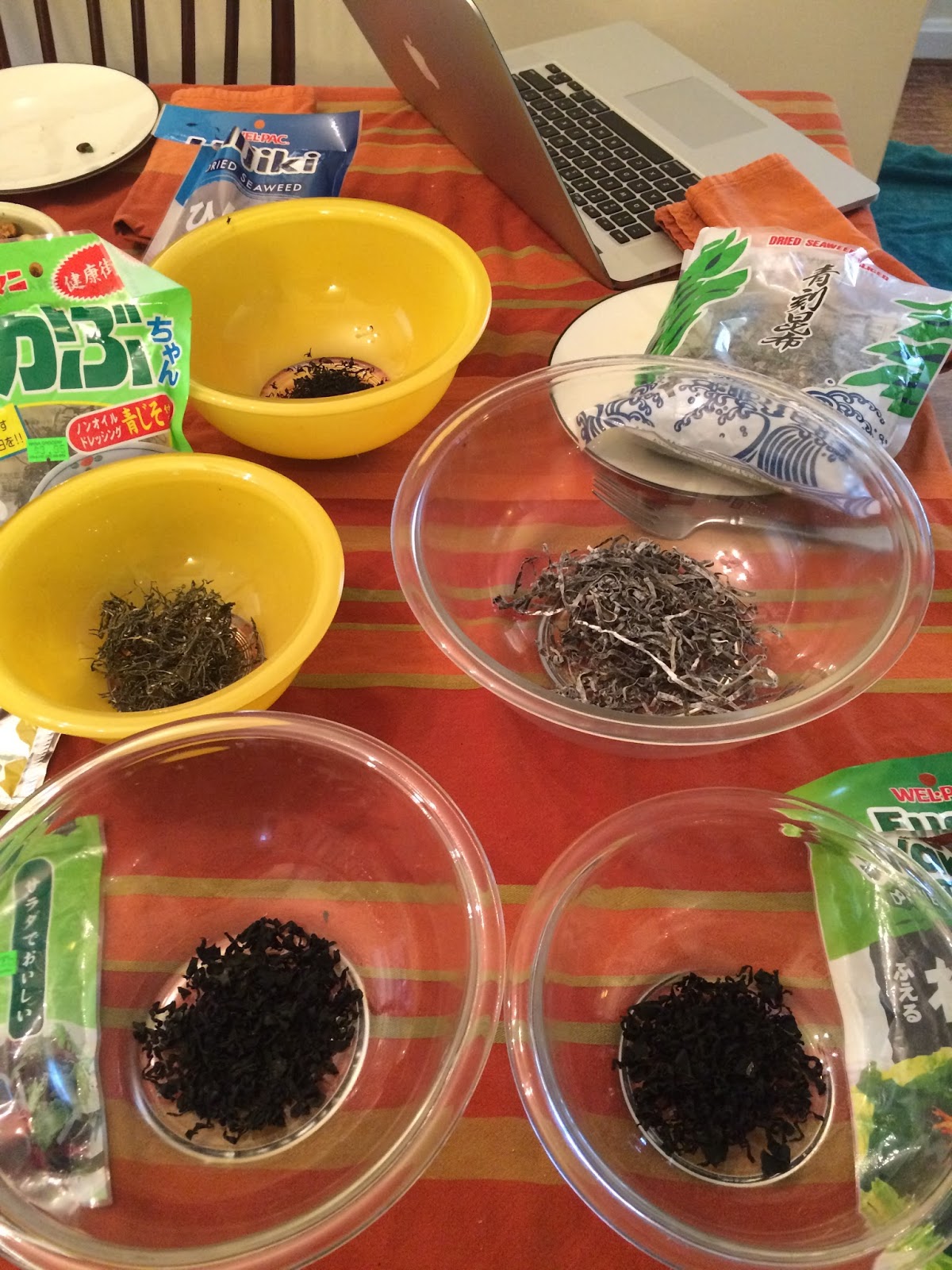

Then you just create a basic dressing of Asian flavors - sesame oil, soy sauce, etc. (we also used rice vinegar, ponzu, honey, and some grated ginger), dress it, add sliced green onions and sesame seeds, done. We had picked up some prepared seaweed salad to compare it against. We hadn't lucked on grabbing the same type of seaweed you usually find in ready-made seaweed salad, and I do love the texture of that type, so that was a bummer. But the flavor of the homemade, by comparison, was much better. Once we had it to compare, we realized that the stuff you normally get at sushi joints is REALLY REALLY sweet.


Commercial on the left - homemade on the right
All the delicious nibblies (including some tiny pickled octopus
we picked up and a quick spicy Napa slaw with sriracha pickled radishes)
What did we drink? Chef Spouse started us out with a rum-based cocktail with ponzu and pimento bitters, garnished with lychee. Mad Kitchen Scientist had taken some of the absurdity of dried hibiscus flowers we were left with from making homemade bitters (which I never wrote about, because there really isn't much to say - you buy a bunch of odd ingredients from places like Mountain Rose Herbs, put really small quantities of them in Everclear, and wait) and turned them into a hibiscus liquor (rum based, with some "warm" spices and a little honey), and Chef Spouse was messing around with rum and rye and bitters and citrus, and what we eventually realized is: just put the hibiscus liquor in a glass with some silver tequila. Simplicity on the other side of complexity, my friends.

What we learned is that it takes a little longer to make fresh alkaline noodles than fresh pasta - but not much. They taste a lot better than Top Ramen. And you can do it with ingredients you already have in your kitchen, so don't be afraid of the mad chemist-sounding names.

(But Chef Spouse ordered some potassium carbonate and kan sui from Amazon anyway.)


07 November 2017

Food Lab 41: Dim Sum

As you might have guessed from my previous Lab post, the Chinese Banquet lab was a bit of a blur. The Pathological Entertainer had the full picture of where we were, where we were going, and how we were going to get there in her head, but the rest of us were merely the sous, following her instructions as we moved from task to task. And we brought it off - 8 courses totaling 15 different dishes, all prepared in about 6 hours, and none of us too exhausted to enjoy eating the meal.

We figured we better hit some of these again pretty soon to solidify our techniques. And it turned out to be a good thing we did, because we still need some work on a few.

Our Dim Sum menu consisted of:

  • Red stewed eggs
  • Roast pork loin (which Mad Kitchen Scientist and The Executive Committee prepared in advance)
  • Sichuan eggplant
  • Momofuku-style pork buns (with two different pork belly preparations to fill them)
  • Salt and pepper squid (that ended up being salt and pepper octopus, because I bought the wrong cephalopods at the fish market)
  • Potstickers (shrimp, veg, and pork)
  • Shao mai (shrimp, veg, and pork)
  • Rambutan for dessert 
I think the rambutan look kind of like sea urchins.

Following The Pathological Entertainer's lead, we did this in three major courses: eggs, pork loin, and eggplant; buns and octopus; dumplings.

As I mentioned, the pork loin arrived ready to eat, so our first course prep was fairly simple: red stewed eggs and the eggplant (provided by a volunteer plant in The Executive Committee's garden).

Red stewing is a simple technique. For eggs, you hard boil them, peel them, and them simmer them in enough liquid to cover in roughly the following proportions

1/3 c. soy sauce
1 1/2 c. water
1 Tbsp. red wine vinegar
1 Tbsp. dry sherry (or, in our case, shaoxing wine)
Seasonings (in our case, a little sugar, star anise, pink and white pepper corns, quite a bit of sliced ginger)

How long? A while. Once the eggs color up, take one out to taste. If you like it, you're done. If not, let them simmer a while longer. (Oh - and save the liquid when you take the eggs out, because you can use it again.)

Red stewed eggs, stewing

For the Sichuan eggplant, Mad Kitchen Scientist sauted the chopped eggplant with appropriate seasonings (garlic, ginger, jalapeƱos), then sauted ground pork, them combined them with a "combo of Chinese flavors" sauce (I know soy and vinegar went into it, but I'm not sure what else he grabbed - hot bean paste is traditional, sherry or shaoxing wine can go in, chili sauce works, too, as does sesame oil - it's up to you how you like it flavored and how spicy you want it), then cooked it down and topped it with a blizzard of chopped scallions before serving.


Then it was on to the buns. Momofuku-style pork buns are like little steamed bun tacos, rather than being a solid bun with the pork completely encased inside, so the buns and the pork are cooked separately and then combined before eating.

The buns are a yeast dough that has multiple types of leavening (yeast, baking soda, and baking powder), and quite a bit of fat (milk powder or, as we did it, milk and rendered bacon fat), so it's lovely to work with.

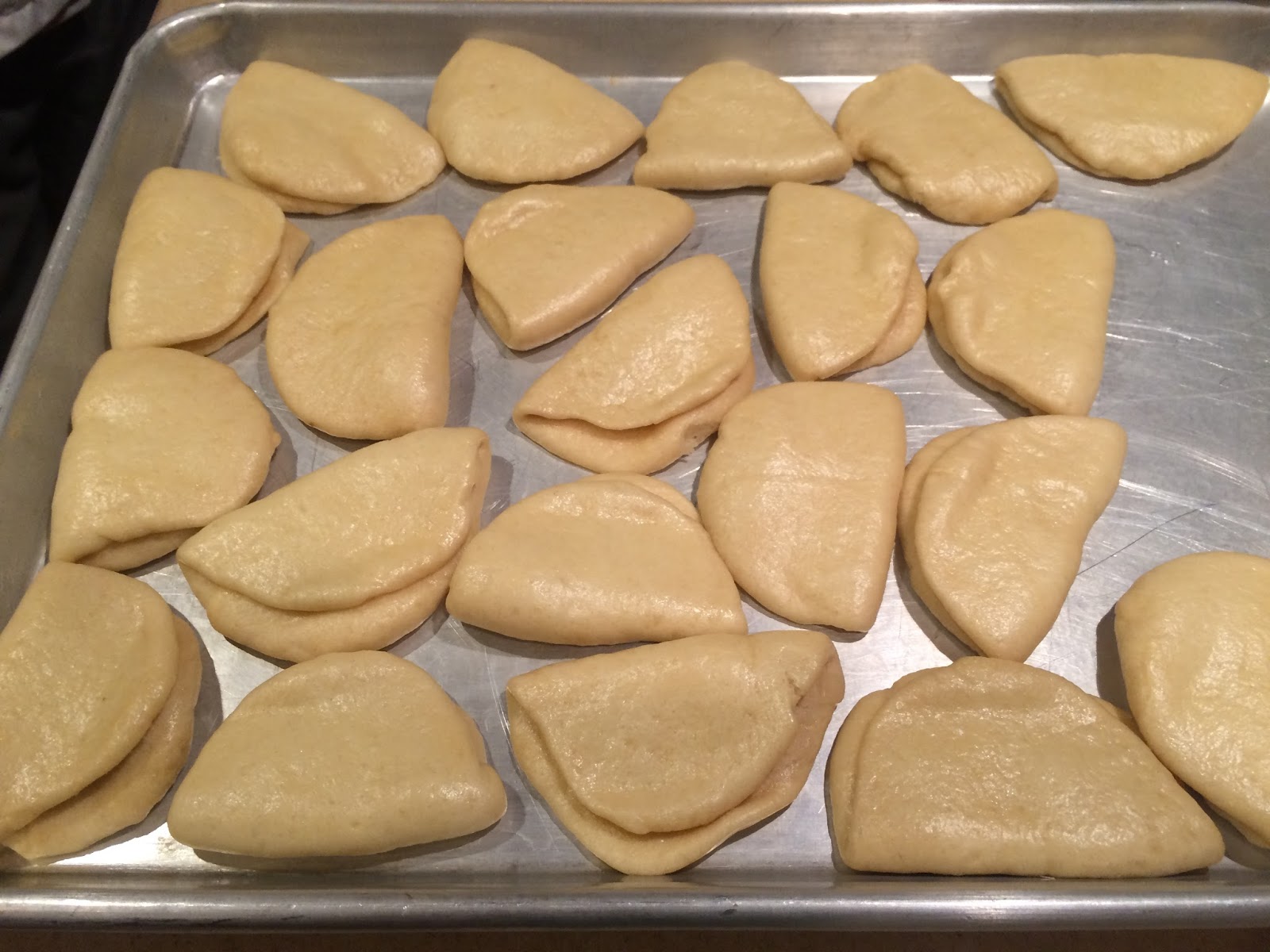
We pretty much followed the bun recipe as written, other than when it came time to roll the buns out, rather than painting the middle with plain vegetable oil, I used sesame oil for more flavor. Warning: it makes A LOT. We had 50 total before one of our cats got bored waiting for her dinner and swatted a few off the tray where they were rising to play with/attract our attention (she is DEFINITELY the cat who is willing to be naughty to get attention).

Rising

Into the steamer

Out of the steamer
For the pork belly, we tried two options: the simpler Food 52 preparation and the more complex Woks of Life preparation. Chef Spouse was not fully pleased with either one. The Food 52 texture was better, although we quickly discovered that starting it at 450 degrees was much too hot. The Woks of Life flavor was better (not surprising, considering it calls for adding more flavors to the meat). But neither developed nice cracklings. On both, the skin ended up so hard as to be totally inedible and mostly even uncuttable. So that was disappointing, because pork cracklings are DELICIOUS.

Woks of Life pork belly (sorry about the steamy-ness)

Food 52 pork belly (as I said, starting it at 450 was too hot)
We then stuffed the buns and added hoisin sauce and homemade pickles. The buns were tasty, no doubt, but I think we could up our pork belly game with a little more experimentation.


Salt and pepper squid is a favorite dim sum dish of mine. Actually, I pretty much love anything with tentacles. Unfortunately, at the fish market, I wasn't paying close enough attention, and got small octopus rather than squid. They tasted just fine, and we were able to use the same prep method, but they were a little less tender than the squid would have been.

It's a pretty simple technique: rinse, drain, chop, and marinate your tentacles (we used a combo of sesame oil and more shaoxing wine). Dredge in a combo of regular wheat flour, semolina flour, corn meal, salt, and white pepper. Deep fry. Drain. Sprinkle while hot with more salt and pepper. Stir fry with garlic, ginger, and jalapeƱos. YUM.

TENTACLES!
Then it was on to the dumplings. We'd prepared three fillings: shrimp, ground pork, and veg (well, really mushroom) to use with two techniques (shao mai and potsticker). The fillings were pretty simple: the main ingredient chopped fine, plus ginger, garlic, napa cabbage, green onion and some soy and sesame oil.

For potstickers, you fill your wrappers (not too full), seal them, sear them in as little oil as possible, then finish them with a short steam. In the first round - the shrimp - we added a little too much water to pan for the final steam, and they sort of fell apart on us. The pork and mushroom were more successful. But we did notice that the wrappers we had purchased seemed to be on the thin side.

Shrimp - see how the ones at the bottom are kind of falling apart?

Mushroom - more successful

Pork - also more successful
Yeah, that thing with the thin wrappers totally bit us in the ass for the shao mai. For shao mai, you fill your wrappers more full and gather up the sides into a little bag, leaving the top open, pack them into a single layer, and steam.
Looks good, but don't be deceived
Simple, right? Looks pretty, right?

Yeah, those thin wrappers completely stuck to each other. We ended up with a solid mass shao mai cake. A shao make, if you will.

Oops. 
Clearly, dumplings are going to require further investigation. And probably using a different brand of won ton wrappers.

To drink, Chef Spouse made us Mai Tais with his latest bar ingredient addition: velvet falernum. We also made a round of ponzu-based drinks: gimlets and last words, where we replaced half the fresh lime juice with ponzu. The last words were good, but the gimlets were outstanding. I think the green chartreuse kind of muted the ponzu, where it really shone in the simpler drink.

As Mad Kitchen Scientist pointed out, this is the second time we've been defeated by Asian cuisine (remember our disastrous attempt to make our own rice paper?), which clearly means another lab is in order.