Showing posts with label eggs. Show all posts

25 February 2019

Food Lab 45: Almond-Flour Cookies

I grew up outside of Philadelphia, in southeastern Pennsylvania. As such, I had a lot of Italian-American friends growing up. When I was in elementary school, one of my close friends came from a large Italian family that owned a local bakery. One of the first times I went over to her house, her mom made spaghetti with red gravy for dinner. When I was served, I proceeded to cut up my spaghetti into bite-sized lengths. My friend's dad took one look at my mutilated pasta, picked up my plate, scraped the sad little chunks into the trash, refilled my plate, and taught me how to eat my pasta properly, deftly twirling the long strands around the tines of my fork. Thus began my life-long love affair with Italian cuisine.

My neighborhood in DC has undergone significant transitions over the years, one of which was the loss of an outpost of Baltimore's famous Vaccaro's. When that shop shut down, I lost my local connect for cannoli, coconut macaroons, and, most distressing, amaretti.

For those who've never had them, amaretti are the MOST delicious cookie in the world. Crisp on the outside, soft in the middle, with a delicate but pronounced almond flavor and just the right level of sweetness, they cannot be beat.

I've been up in Baltimore twice in the past six months, once for business, once for fun, BOTH times in walking distance of Vaccaro's. So both times, I brought home two dozen amaretti. As I was savoring the last one, I realized: these cannot be that difficult to make. Looking up recipes confirmed it. Clearly, Food Lab: Amaretti was too small a topic.

Ah, but there is another famous cookie made with almond flour and egg whites: French macarons. Conveniently, my bestie is downsizing and recently gave me an all-macaron cookbook she'd picked up on a whim a few years ago. Now we have a worthy Food Lab topic!

The macaron concept is simple (what follows is adapted from Entertaining With Beth).

You will need the following special equipment: a highly accurate digital scale, a fine-mesh sieve, an electric mixer, a pastry bag with a plain round tip, rimless cookie sheet(s) and silpat(s)

Sift 120g very finely ground almond flour + 200g powdered sugar through a fine sieve into a bowl and set aside.


Whip the whites from three ROOM TEMPERATURE eggs until they start to foam, then add a pinch of salt, 50g of granulated sugar (that you can omit if you're finding your macarons too sweet), and 1/4 tsp cream of tartar (do NOT omit this - it's the secret ingredient to REALLY FLUFFY egg whites), and continue to whip them HARD for 8-10 minutes. You basically want the egg whites to end up the consistency of whipped cream, so you're going to need to use an electric mixer or a LOT of elbow grease - I recommend the mixer.


Combine the whipped egg white mixture with the dry ingredients mixture (I found it easier to pour the dry into the whipped eggs), stirring ~70 times with a rubber spatula, then pipe onto silpat-lined rimless cookie sheets. As Beth explains well in the link above, it's important to neither under- nor over-mix your batter. Flaws - cracked cookies, no "feet," cookies that spread out too far - are usually a result of mixing errors.

You can really pipe any size you choose. We went with piping roughly 1 inch diameter rounds, which gave us approximately 60 cookies per batch (so 30 once paired). I would think making them much smaller would be difficult, but you can certainly make them larger if you like.


Bang them on the counter hard a few times to settle any air bubbles, let them rest and set for 30-60 minutes (at which point you can pat down any little peaks you may have created in piping them out), then bake for 20 minutes at 300 degrees. The resting time is also important for the formation of their distinctive "feet." Don't short it.

Once the cookies are cool, take them off the silpat and make little sandwiches by piping on buttercream filling.

We tested the silpat versus a single-tasker macaron mat versus parchment paper. Go with the silpat. The single-tasker is now in the garbage where it belongs, and even the parchment paper sometimes didn't want to release the little buggers.

Basic buttercream: beat 1/2 stick (1/4 c.) room temperature unsalted butter, then slowly add in ~3/4 c. powdered sugar

Now, that all is going to give you a macaron, but it will be kind of dull. How do they make all those pretty colors and flavors you see at bakeries?

Well, the cookie colors are a result of adding food coloring to the eggs while you're whipping them (except in the case of chocolate cookies, which are the result of adding 10g of cocoa powder to the dry mix).

The cookie flavors (again, aside from chocolate) are a result of adding 1/2 tsp of the extract of your choice to the eggs while you're whipping them.

We chose to make vanilla (with extract), chocolate (with 10g cocoa powder), lemon (with extract and food coloring), rose (with rose flower water and food coloring), and coconut (with extract) cookies. We decorated the coconut cookies with a little sprinkle of flake coconut on top before baking (also so we could visually differentiate them from the vanilla cookies).

Chocolate, on parchment paper

Rose (color from red food coloring), on my beloved silpat

Vanilla, on the damn single-tasker, to which several of the cookies stuck
All the cookie batter came out quite consistent OTHER than the lemon. It's possible we whipped the eggs a little less, or it may have been that lemon extract includes some lemon oil. As you can see from the pictures above of the chocolate, rose, and vanilla cookies just out of the oven, the other batters were quite firm and stayed exactly where and as piped, including lumps, bumps, and ridges. The lemon, as you can see in the picture below, was definitely smoother, but it was much harder to pipe (as The Executive Committee discovered to her dismay, having drawn the "pipe" straw for that batch).


You can, of course, also flavor and color your buttercream. In fact, if you flavor your buttercream, you *should* color it so you can identify what's what.

We made the following icings:

  • Hazelnut (adding about 1/8 c. very finely ground nuts)
  • Macadamia (same)
  • Orange (adding about a tsp. of orange extract and food coloring)
  • Cherry (adding 1 oz. Ginja Licor - a Portuguese sour cherry brandy - and food coloring)
  • Coffee whiskey (adding 1 oz. bourbon and espresso powder to taste)
  • Passionfruit (adding about 2 oz. passionfruit puree and food coloring)
  • Rose (adding about 1 oz. rose flower water and food coloring)
  • Chocolate (adding about 2 tsp. cocoa powder)

(We went a little nuts)

We were able to incorporate the nut pastes and cocoa powder without having to put the buttercream back in the mixer. Any time you're trying to incorporate any sort of liquid, don't try to do it by hand - it's a pain in the ass and takes forever. Also, if you add liquid, you're going to need to add a bit more powdered sugar as well. I can't tell you how much - you just have to watch the consistency and add until it's right.

We ended up with the following combinations

  • Chocolate hazelnut
  • Chocolate orange
  • Vanilla cherry
  • Vanilla coffee whiskey
  • Rose rose
  • Rose chocolate
  • Rose cherry
  • Lemon passionfruit
  • Coconut macadamia
  • Coconut chocolate 


We ended up with a total of about 150 macarons. Which, I'll admit, is a lot. 


The universally esteemed winning combinations were:

  • Lemon passionfruit
  • Rose cherry
  • Coconut macadamia
  • Chocolate hazelnut 


You can eat them right away, but they're better if you give them a little time for the filling to meld with the cookie. Store them in the fridge to keep your buttercream firm (but remember to let them warm up before you eat them), or, if you'll be storing them for more than a few days, freeze them.

The sky is really the limit on colorings and flavorings. The cookbook my friend gave me has all sorts of options - savory varieties using ingredients like beets, carrots,  and herbs, various sorts of sweet and savory tea-infused varieties, ganache fillings, jam fillings, caramel fillings, cream cheese fillings, berry fillings, lemon curd...really, once you have the basic technique down, you're only limited by what flavor combinations you find appealing. We all realized we'd missed an opportunity for chocolate mint (either chocolate cookies with mint filling or vice versa). Next time.

What about the cookies that inspired this whole thing in the first place? Did I even make amaretti?

I did, right at the end. As I mentioned, they are dead simple to make (adapted from the recipe at Love & Olive Oil):

Combine 2 1/4 c. almond flour, 1 c. granulated sugar and 1/2 tsp salt in a bowl

Whip the whites from two ROOM TEMPERATURE eggs until they start to foam, then add a pinch of salt, 1/4 tsp. cream of tartar, and 1/2 tsp. almond extract and continue whipping the mixture to soft peak stage (4-5 minutes)

Mix the whipped egg whites into the dry ingredients with a rubber spatula. No need to be gentle - in fact, I ended up basically kneading the dough at the end.

Roll dough into 1 inch balls, roll the dough balls in powdered sugar, space about 1 inch apart on a silpat-lined cookie sheet, bake at 300 for 30-35 minutes. Makes about 2 1/2 dozen cookies.


These are really good cookies. Are they as good as Vaccaro's? No. The consistency is perfect, but I think the almond flavor needs to be stronger. The thing is, almond extract is pretty powerful stuff, so some initial caution is warranted.

All three recipes I found used 1/2 tsp. of almond extract, but one recipe used that for 3 1/2 c. almond flour, and the other used it for 1 c. almond flour, so I chose the midpoint of the three. And since we'd already made FIVE full batches of macaron batter and had to go back to the store TWICE for more powdered sugar, and I used the last of the almond flour for the one batch of amaretti I made, I wasn't about to put the rest of the crew through multiple rounds of amaretti as well. Also by this point, it was after 8 pm, we hadn't had dinner yet, and everyone was starting to get cranky.

Other options I've seen that I'll try in future test runs include:

1. Add the zest of one lemon to the dry ingredients (which I would think might enhance the almondyness of the almond extract)

2. Increase the almond extract to 1 tsp.

3. Keep the almond extract at 1/2 tsp. but also add 1/2 tsp. of Amaretto liqueur (this is probably where I'll start)

4. Use *bitter* almond extract (if you can find it)

Regardless, it looks like I'll be adding a new pantry staple: almond flour.


07 November 2017

Food Lab 41: Dim Sum

As you might have guessed from my previous Lab post, the Chinese Banquet lab was a bit of a blur. The Pathological Entertainer had the full picture of where we were, where we were going, and how we were going to get there in her head, but the rest of us were merely the sous, following her instructions as we moved from task to task. And we brought it off - 8 courses totaling 15 different dishes, all prepared in about 6 hours, and none of us too exhausted to enjoy eating the meal.

We figured we better hit some of these again pretty soon to solidify our techniques. And it turned out to be a good thing we did, because we still need some work on a few.

Our Dim Sum menu consisted of:

  • Red stewed eggs
  • Roast pork loin (which Mad Kitchen Scientist and The Executive Committee prepared in advance)
  • Sichuan eggplant
  • Momofuku-style pork buns (with two different pork belly preparations to fill them)
  • Salt and pepper squid (that ended up being salt and pepper octopus, because I bought the wrong cephalopods at the fish market)
  • Potstickers (shrimp, veg, and pork)
  • Shao mai (shrimp, veg, and pork)
  • Rambutan for dessert 
I think the rambutan look kind of like sea urchins.

Following The Pathological Entertainer's lead, we did this in three major courses: eggs, pork loin, and eggplant; buns and octopus; dumplings.

As I mentioned, the pork loin arrived ready to eat, so our first course prep was fairly simple: red stewed eggs and the eggplant (provided by a volunteer plant in The Executive Committee's garden).

Red stewing is a simple technique. For eggs, you hard boil them, peel them, and them simmer them in enough liquid to cover in roughly the following proportions

1/3 c. soy sauce
1 1/2 c. water
1 Tbsp. red wine vinegar
1 Tbsp. dry sherry (or, in our case, shaoxing wine)
Seasonings (in our case, a little sugar, star anise, pink and white pepper corns, quite a bit of sliced ginger)

How long? A while. Once the eggs color up, take one out to taste. If you like it, you're done. If not, let them simmer a while longer. (Oh - and save the liquid when you take the eggs out, because you can use it again.)

Red stewed eggs, stewing

For the Sichuan eggplant, Mad Kitchen Scientist sauted the chopped eggplant with appropriate seasonings (garlic, ginger, jalapeƱos), then sauted ground pork, them combined them with a "combo of Chinese flavors" sauce (I know soy and vinegar went into it, but I'm not sure what else he grabbed - hot bean paste is traditional, sherry or shaoxing wine can go in, chili sauce works, too, as does sesame oil - it's up to you how you like it flavored and how spicy you want it), then cooked it down and topped it with a blizzard of chopped scallions before serving.


Then it was on to the buns. Momofuku-style pork buns are like little steamed bun tacos, rather than being a solid bun with the pork completely encased inside, so the buns and the pork are cooked separately and then combined before eating.

The buns are a yeast dough that has multiple types of leavening (yeast, baking soda, and baking powder), and quite a bit of fat (milk powder or, as we did it, milk and rendered bacon fat), so it's lovely to work with.

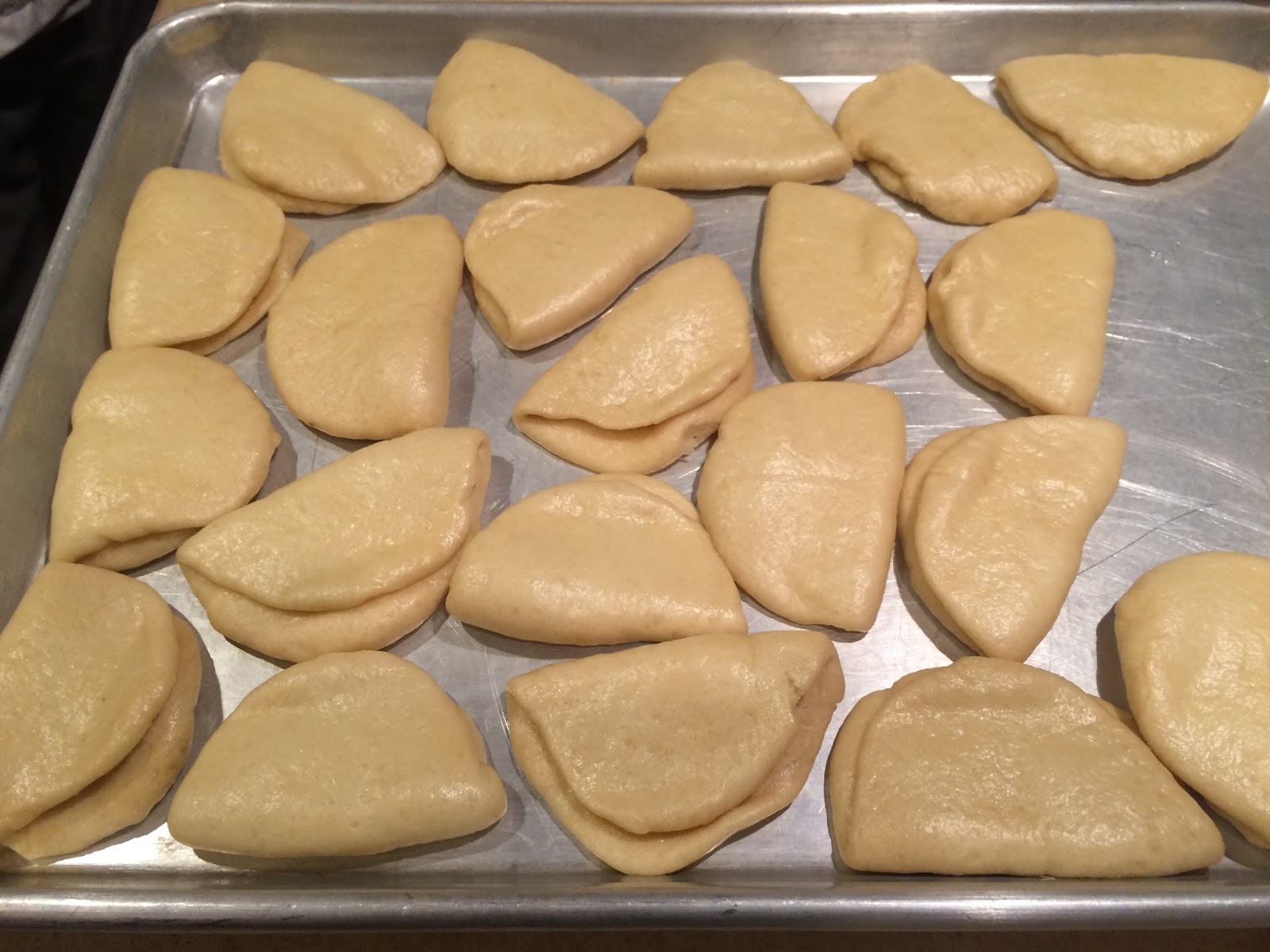
We pretty much followed the bun recipe as written, other than when it came time to roll the buns out, rather than painting the middle with plain vegetable oil, I used sesame oil for more flavor. Warning: it makes A LOT. We had 50 total before one of our cats got bored waiting for her dinner and swatted a few off the tray where they were rising to play with/attract our attention (she is DEFINITELY the cat who is willing to be naughty to get attention).

Rising

Into the steamer

Out of the steamer
For the pork belly, we tried two options: the simpler Food 52 preparation and the more complex Woks of Life preparation. Chef Spouse was not fully pleased with either one. The Food 52 texture was better, although we quickly discovered that starting it at 450 degrees was much too hot. The Woks of Life flavor was better (not surprising, considering it calls for adding more flavors to the meat). But neither developed nice cracklings. On both, the skin ended up so hard as to be totally inedible and mostly even uncuttable. So that was disappointing, because pork cracklings are DELICIOUS.

Woks of Life pork belly (sorry about the steamy-ness)

Food 52 pork belly (as I said, starting it at 450 was too hot)
We then stuffed the buns and added hoisin sauce and homemade pickles. The buns were tasty, no doubt, but I think we could up our pork belly game with a little more experimentation.


Salt and pepper squid is a favorite dim sum dish of mine. Actually, I pretty much love anything with tentacles. Unfortunately, at the fish market, I wasn't paying close enough attention, and got small octopus rather than squid. They tasted just fine, and we were able to use the same prep method, but they were a little less tender than the squid would have been.

It's a pretty simple technique: rinse, drain, chop, and marinate your tentacles (we used a combo of sesame oil and more shaoxing wine). Dredge in a combo of regular wheat flour, semolina flour, corn meal, salt, and white pepper. Deep fry. Drain. Sprinkle while hot with more salt and pepper. Stir fry with garlic, ginger, and jalapeƱos. YUM.

TENTACLES!
Then it was on to the dumplings. We'd prepared three fillings: shrimp, ground pork, and veg (well, really mushroom) to use with two techniques (shao mai and potsticker). The fillings were pretty simple: the main ingredient chopped fine, plus ginger, garlic, napa cabbage, green onion and some soy and sesame oil.

For potstickers, you fill your wrappers (not too full), seal them, sear them in as little oil as possible, then finish them with a short steam. In the first round - the shrimp - we added a little too much water to pan for the final steam, and they sort of fell apart on us. The pork and mushroom were more successful. But we did notice that the wrappers we had purchased seemed to be on the thin side.

Shrimp - see how the ones at the bottom are kind of falling apart?

Mushroom - more successful

Pork - also more successful
Yeah, that thing with the thin wrappers totally bit us in the ass for the shao mai. For shao mai, you fill your wrappers more full and gather up the sides into a little bag, leaving the top open, pack them into a single layer, and steam.
Looks good, but don't be deceived
Simple, right? Looks pretty, right?

Yeah, those thin wrappers completely stuck to each other. We ended up with a solid mass shao mai cake. A shao make, if you will.

Oops. 
Clearly, dumplings are going to require further investigation. And probably using a different brand of won ton wrappers.

To drink, Chef Spouse made us Mai Tais with his latest bar ingredient addition: velvet falernum. We also made a round of ponzu-based drinks: gimlets and last words, where we replaced half the fresh lime juice with ponzu. The last words were good, but the gimlets were outstanding. I think the green chartreuse kind of muted the ponzu, where it really shone in the simpler drink.

As Mad Kitchen Scientist pointed out, this is the second time we've been defeated by Asian cuisine (remember our disastrous attempt to make our own rice paper?), which clearly means another lab is in order.


01 June 2011

Food Lab 9a: More -aise-iness

The return of the leftover egg whites . . .

Yes, even with egg-white cocktails, Aise-lab left a surplus of egg whites, but oddly no butter leftovers . . . hmmm.

So as is often the way with food lab, the goodness keeps on coming. In this case, an orange angel cake for the Executive Committee's birthday! Following Joy to a T -- and happily noting that Joy's recipes calls for one-and-a-half cups of egg whites (easily measured) rather than X egg whites (impossible, given the chaotic accretion of egg whites during Aise-lab) -- a light, fluffy temptation is ready to go into the oven:


31 May 2011

Food Lab 9: -aises

As in:

Holland-aise
Bearn-aise
Mayonn-aise

Etc.

When you're going classic, go classic. Our texts for the day? Julia and McGee of course.

According to McGee, there are 5 basic types of Hollandaise:
  1. Careme – cook egg yolks and water based ingredients – whisk in pats of whole butter
  2. Escoffier - warm eggs yolks and water based ingredients – whisk in melted or clarified butter
  3. Simple - bung all ingredients into a cold saucepan – heat on low – stir constantly
  4. Mayonnaise - warm egg yolks and water based ingredients – whisk in clarified butter
  5. Sabayon – whisk egg yolks with water to form a foam – whisk in butter and lemon
How much butter? For that we go to Julia. She says 2 sticks - a full cup - for 3 yolks, but we felt that *might* be a little excessive. We ended up with about 3/4 c. per batch.

What do I mean by "water-based ingredients"? Non-oil-based. Generally a Tbsp of water and a Tbsp of some acid (we mostly used lemon juice).

I could recount it all, but here's the short of it (I was going to write "skinny" but do you have any idea how much butter we ate Sunday?):
  • Use a glass bowl for your double boiler.
  • Forget the clarified butter - it scrambles your yolks. Use pats of cold butter. Which also cuts down on steps.
  • Do not use an immersion blender. You'll end up with mayonnaise. Which is excellent, but not what we're after.
  • You MUST beat the sauce until sticky before adding the butter if you want a nice thick Hollandaise.


When the sauce broke - aka, the clarified butter attempt (and no, metal versus glass bowls didn't make a bit of difference), the McGee method of fixing it did work, at least for a while. Strain the broken sauce to get the solids out, then start with another egg yolk and a Tbsp of water, whisk that, then whisk in the broken sauce. It eventually broke again, but it took about an hour.

The big difference with Bearnaise is that rather than just using lemon juice for your liquid, you use a reduction. The traditional reduction is white wine, white wine vinegar, tarragon and shallots. But we invented something WAY better: deglaise.

What is Deglaise?

You start by preparing scaloppini beef like we did in deglazing lab. Then you prepare a pan sauce, also from deglazing lab.  Then you use THAT for your wine/vinegar reduction part of Bearnaise. Mad Kitchen Scientist actually asked Chef Spouse to marry him after the delivery of this sauce to the table.

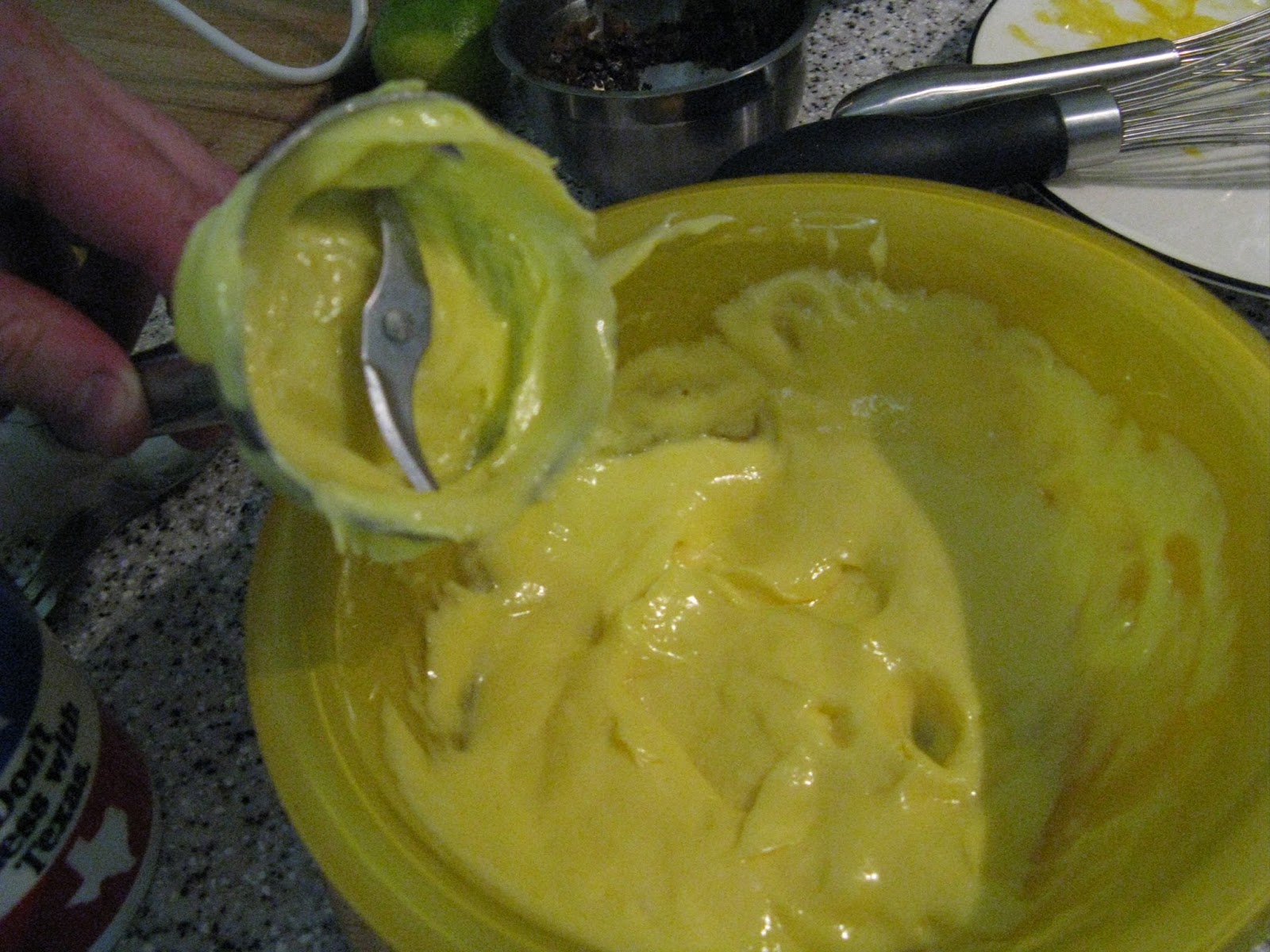
We did also do a Maltaise, which is Hollandaise with orange juice and orange zest added. THAT was an application for the immersion blender, as the added liquid thinned out the sauce considerably. It was delicious, though.

Mad Kitchen Scientist then whipped up a bunch of mayonnaises. Clearly I should've paid more attention, because when I tried to make it tonight to bind our crabcakes, it did not go well. I thought "1 egg yolk, a little vinegar, salt and pepper, then oil until it looks right" seemed clear enough, but apparently not. He did one version using walnut oil, which we decided would be divine on a waldorf salad, and another using sesame oil. It was a little strong initially, but with the addition of some peanut oil and some sriracha was quite nice.


Mama IA made a lemon meringue pie, too, which I heard was fantastic, but I was MUCH too full to partake, not least of which because she made a LOT of meringue, which we turned into a lemon meringue drink with vodka, limoncello, simple syrup and lemon juice.

I leave you with one thought (which was the quote of the day):
"Butter before booze."

14 June 2010

Recipe: Bread Pudding

Every June, we gather a the biggest group we can to go to Wolf Trap's annual Louisiana Swamp Romp - an afternoon of eating, drinking, and dancing to Louisiana music in the sunshine.

The best part about Swamp Romp is that it's just a big party where everyone brings yummy comestibles and a lot of sharing and making friends goes down. We're Team Julep for reasons that probably don't need explaining.  Most years, we set up near Team Crawfish, a great group that comes with a cooler (a hotter?) full of crawfish, corn, and potatoes.  This year, they couldn't come - hence the photo to the right.

This year's menu included:
  • Gumbo (from Donald Link's Real Cajun cookbook, although Chef Spouse has tracked down the recipe for Prejean's famous pheasant, quail and andouille gumbo, but not in time to do a test run)
  • Jambalaya (from a recipe I clipped from...somewhere)
  • Chocolate chip cookies (for making friends with the nearby children)
  • Mint Juleps (for making friends with the nearby adults)

Plus goodies made by the Romp crew:
  • homebrewed beer
  • duck tamales
  • pralines
  • gazpacho
  • ceviche
  • sangria
  • fruit salad
  • more wine
  • more beer
  • Popeye's fried chicken (it's traditional and a seriously delish guilty pleasure)
And...Elizabeth’s New Orleans-style Bread Pudding

This is based loosely on recipes from the Commander's Palace cookbook and from Joy of Cooking.  But here’s the thing to remember about bread pudding: it’s an inexact science. This is a dessert that was created to use up stale bread, so all quantities are approximate.

Anyway....

Butter a 4 qt (ish) casserole dish
Thinly slice about 2 Tbsp. unsalted butter on the bottom of casserole
Spread golden raisins over bottom of casserole

Don't have/don't like raisins?  Use other dried fruit - or even fresh fruit that holds up well to baking (i.e., any kind of stone fruit, apples)

Slice 1 loaf of stale French bread about 1/2 - 1 inch thick

Don't have French bread?  Use whatever you've got - but probably not whole-grain.

Stack the bread tightly in the casserole 

I like a spiral pattern

Sprinkle on some more raisins (for about 1 c. total, give or take)

Make sure you press them down - any fruit that doesn't get coated by the custard mixture will tend to burn

Whisk 3 large eggs in a medium bowl

Have extra yolks hanging around from an egg whites only preparation?  Feel free to substitute 2 yolks for an egg

Add 1 c. heavy cream
2 1/2 c. milk
2 c. sugar
2 Tbsp. vanilla extract
1 tsp. ground cinnamon

You can go heavier on the heavy cream (reduce the milk accordingly) for a richer dish, or heavier on the milk (reduce the heavy cream) for a lighter dish, or replace some (or all) of the dairy with half-and-half.  Use what you have on hand.

Pour custard mixture over the bread and let stand for about an hour

Press bread down into custard mixture several times during the hour it’s resting - this makes sure everything gets fully saturated with the custard mixture before baking, which is what you're after.

Bake at 375 for 1 hour

Meanwhile, make the bourbon sauce:

Melt 1 stick (8 oz.) butter in a heavy saucepan over medium heat

stir in 1 c. sugar
1/3 c. bourbon
1/4 tsp. nutmeg
1/4 tsp. salt

If you like it a little less boozy, you can replace a few Tbsp. of the bourbon with some water.

Cook, stirring frequently, until the sugar dissolves
Remove from heat

Whisk 1 large egg in separate bowl
Whisk egg into bourbon/butter/sugar mixture
Cook over medium heat about 1 minute, whisking continuously, until the sauce thickens


Ok, this is where the magic happens:

When the bread pudding comes out of the oven and while it’s still hot, pour the bourbon sauce over the bread pudding so it soaks in.

You can hang onto a little of the bourbon sauce and re-heat to pour over individual servings when you serve it, but you don't need to. (Actually, you could also make another batch of the bourbon sauce for additional saucing of individual portions, because it keeps in the fridge and it's really good on ice cream, pancakes, waffles, pound cake, shoeboxes....)


07 April 2010

Technique: Scrambled Eggs

Prep a double boiler

Whisk 3 large eggs, 1 Tbsp. heavy cream, and 1/2 tsp. of salt

Alton Brown, aka The Boss of Us, recommends scrambling eggs in a double boiler to provide continuous low heat, and he's right - this does result in awesomely delicious scrambled eggs, but is a mess to clean up - man, does the egg stick to the bowl.

Anyway, more on that in a minute.


Once you've poured your whisked eggs and cream into your double boiler, use a flexible silicon spatula to scrape them up continuously until they achieve the desired degree of doneness.

The faster you scrape, the smoother texture your eggs will have.  As far as doneness?  It's a matter of taste, but you need to remove the eggs from the heat a little runny for your taste because the hot eggs will continue to cook off the heat.

To go over the top? Smear a little goat cheese on the hot eggs.

A few notes:

Chef Spouse has tried a variety of options to make the cleanup a little easier.  The type of bowl does not seem to make a difference.  A little browned butter in the bottom improves the flavor, but does not help with the cleanup either.

And of course, the downside of using a double boiler is that you have to hold the bowl, and it's hard to hold still, because the steam comes up and hits your arm.

Chef Spouse realized that the key is that your pan cannot have any sharp edges where something might collect, which will wreck the texture. So you can skip the double boiler if you have a good heavy weight saucier pan and a cooking surface with consistent and easily adjustable temperature.  In other words, an All-Clad saucier on low to med-low on a Viking gas range obviates the need for the double boiler.

Chef Spouse is constitutionally disinclined to nonstick pans, but he loves making scrambled eggs this way so much he's considering getting one.


04 April 2010

Technique: Poached Eggs

As with most cooking techniques, we base our findings on Alton Brown, with a few changes.

Break a fresh egg into a small bowl or ramekin


Bring water to a boil in a saucepan

We generally do a smallish saucepan and do one egg at a time

Add green herbs

Tarragon is awesome and classic, but anything that's not an oily herb - like rosemary - and that you like with eggs would work.  Use more than you think - we generally use several large sprigs.

Shut off the water and add 1 Tbsp. of white vinegar per cup of water in the pan

This is quite a bit more vinegar than most recipes call for, but we found, in testing the amounts, that this quantity produced the best results in egg texture.

As soon as the water settles, tilt the pan and pour the egg gently into the side towards where the pan is tilted.  Keep the pan tilted until the egg starts to set up.

The water cannot be moving AT ALL when the egg goes in.  We found that this method is more sure than the traditional swirl the water and drop the egg in the center, because if you miss with that, it makes a mess - and it's easy to miss.

After 3 minutes, remove the egg using a slotted spoon and serve.

30 March 2010

Recipe: Ramos Gin Fizz

The Brennan family hasn't let us down yet.  Can the people behind Bananas Foster ever go wrong?  But we do need to give a shout-out to the Carousel Bar at the Hotel Monteleone.  A dash of orange flower water?  I think not.

2 oz. half-and-half
1 1/2 oz. gin (we like Leopold's - its floral notes match well with the drink)
1/2 oz. simple syrup
2 tsp. lemon juice
1 egg white
Orange flower water (4-5 dashes)
Vanilla extract (about a dash)

Combine all in a shaker, and shake until your arm is about to fall off.  Then shake some more.  Strain into a rocks glass and serve immediately, while everyone can admire your shaking skills.

Do I need to tell you that the lemon juice needs to be fresh or how to make simple syrup?  No - otherwise what are you doing here?

The Sazerac Bar at the Roosevelt Hotel also makes an excellent Ramos Gin Fizz.  Clearly, more research is required.


23 March 2010

Recipe: Bourbon Milk Punch

This is (basically) the Commander's Palace recipe.  Pete Fountain can't be wrong.

1 1/2 c. 2% milk
1/2 c. heavy cream
12 oz. bourbon (Maker's Mark is the rail in our house)
1 egg white (NOT optional, even if the recipe says it is)
1/2 c. simple syrup
1 Tbsp. vanilla extract (the real stuff, not the fake stuff)

Combine the milk, cream, bourbon, egg white, sugar, water and vanilla in a pitcher. Mix using an immersion blender. Serve over rocks in old fashioned glasses with a grind of nutmeg on the top.


22 March 2010

Food Lab 1: Eggs

We decided to hold the very first Food Lab on March 21 in honor of my birthday. Between eggs being one of the building blocks of cuisine, the players desiring to gather on the early side because it was a Sunday, the variety of great brunch drinks you can make with eggs, and my own love of - and inability to make - poached eggs, the subject was obvious.

So Mad Kitchen Scientist, The Executive Committee, Chef Spouse, Papa IA by Day-Chef by Night, Mama IA by Day-Chef by Night, and I gathered at our house to learn everything we could about eggs.

Now, I love poached eggs.  But we've had no luck poaching eggs.  Chef Spouse had proposed getting an egg poacher, but I'm with Alton Brown on this - no single taskers.  So we will poach eggs in a pot of water or not at all.  We tried plain water and vinegared water.  We tried just off the boil and just steaming.  We tried adding herbs into the water.  We tried dropping the eggs in the water and poaching them in various vessels.  Yes, we ate a lot of eggs.  In the end, the winner was water off the boil (no heat), 1 Tbsp. white wine vinegar, tarragon in the water, egg straight in, 3 minutes.  Perfection.  Yes, you need to use a LOT of tarragon - and thanks to Papa IA by Day-Chef by Night for the idea - but it's awesome.  Grow your own.  Buying fresh herbs is too expensive.


Mad Kitchen Scientist had made some Parker House rolls for us, so in between poaching and eating eggs and eating the rolls, we decided to try baking some eggs in the rolls.  It did not thrill.

In the meantime, Mama IA by Day-Chef by Night started making some divinity, which is a really old-skool traditional southern candy that's made with egg whites, and, if it doesn't set up properly, comes out kind of like marshmallow fluff.  Yes, I know that from recent experience.  Why do you ask?


Back to the eggs:  now we were on to scrambled.  We decided to try Alton Brown's double boiler method.  When you're starting to play around with ingredients, you can't go wrong with Alton Brown.  Everything Alton says about whisking the curd as it forms is true.  Everything Alton says about low heat is true.  The cleanup is a mess - the eggs never brown, so a fair amount sticks to your inner bowl and is a bitch to remove. But the eggs?  Divine.  Even better with a schmear of goat cheese (once again, a Papa IA by Day-Chef by Night innovation.  He rules.).  You know what didn't work?  Bourbon scrambled eggs.  Yuck.  But you don't know until you try

We also enjoyed a cornucopia of egg-based drinks:  Ramos Gin Fizzes, Bourbon Milk Punch, and champagne.  Well, OK, champagne's not egg-based, but it goes with everything.

We finished the day with fantastic chocolate souffles, courtesy of Mad Kitchen Scientist (who was totally looking for an excuse to buy a bunch of ramekins) and The Executive Committee.  Recipe to follow.


Verdict?  Fun day, we all learned to poach and scramble eggs perfectly, we were more than a little buzzed, our cholesterol counts were off the charts, and Food Lab was a hit.