Showing posts with label butter. Show all posts

02 January 2012

Food (Mini) Lab 13: Choux Pastry

Pate a Choux has a reputation for being...difficult. Like a beautiful but high maintenance woman, before approaching it, you tend to ask yourself, "Is this really worth it?"

To that, I say: "Hot from the oven gougeres? Not worth it? Are you CRAZY?"


Also, here's a secret: choux pastry isn't that hard.

Really.

Pre-heat the oven to 400 degrees.

Take 4 eggs out of the fridge (they need to come to room temperature).

Boil 1 c. of liquid (all milk, milk and water, or milk and stock for savory applications) with 1/4 lb. of butter (cut up) and about 1/2 tsp. of salt over medium heat.


While still over the heat, stir in 1 c. of flour. It's going to look, as Chef Spouse pointed out, like a bechamel sauce gone wrong. Don't worry - keep stirring! Eventually, it will get kind of satiny looking. When that happens, turn off the heat.


Let the choux cool slightly.

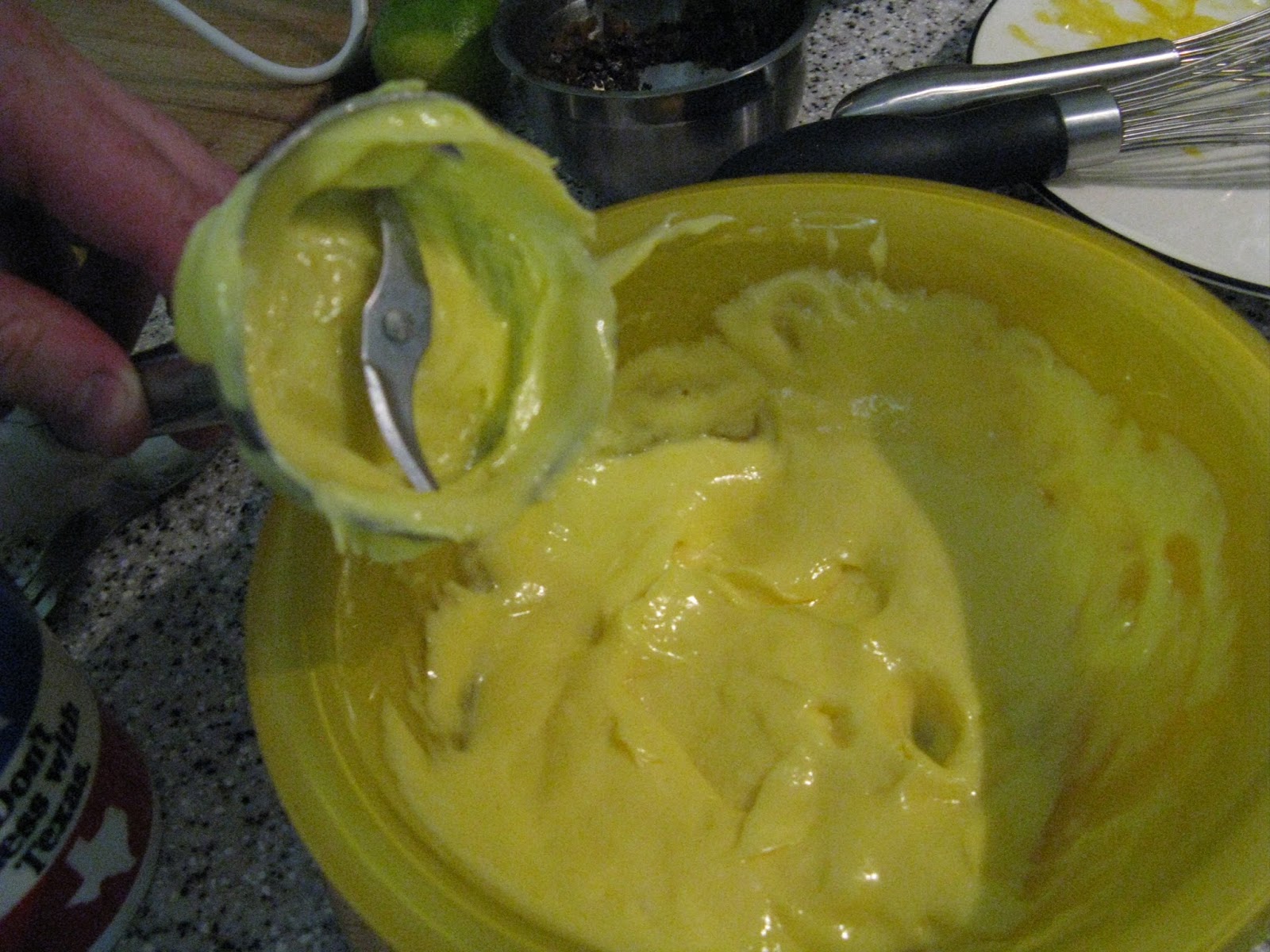
Pop it into a bowl and start mixing in the eggs one at a time. Initially, the egg/dough mixture is going to look weird, and you'll be thinking that the dough is messed up and not going to come together. Don't worry - keep stirring! Once the first egg is incorporated, keep doing the same with the other three eggs. At the end, you'll once again have a lovely satiny dough.


Then you load up your pastry bag, pipe your choux onto a baking sheet, and pop it in the oven. 10 minutes at 400, then 20 minutes at 350, then flaky pastry goodness.

What should you pipe it like? Depends on what you're going to do with it - you can pipe it into 1-2 tsp mounds for savory or sweet fillings, rectangles for eclair applications, a ring for a pastry cake (see Julia Child's The Way to Cook for an example) - whatever you like.

What should you fill it with? The Mad Kitchen Scientist had pre-prepared mushroom duxelles and a Moroccan lamb thing for the New Year's Eve party. Of course, ice cream (for profiteroles) or cream (for cream puffs) are traditional sweet fillings. You can mix cheese into the dough before cooking for gougeres. We were speculating that you could make LARGE puffs as a basis for poached eggs. Really, the only limit is your palate/imagination.

So don't be scared - ask that pretty lady to have a drink. Appearances can be deceiving.


31 May 2011

Food Lab 9: -aises

As in:

Holland-aise
Bearn-aise
Mayonn-aise

Etc.

When you're going classic, go classic. Our texts for the day? Julia and McGee of course.

According to McGee, there are 5 basic types of Hollandaise:
  1. Careme – cook egg yolks and water based ingredients – whisk in pats of whole butter
  2. Escoffier - warm eggs yolks and water based ingredients – whisk in melted or clarified butter
  3. Simple - bung all ingredients into a cold saucepan – heat on low – stir constantly
  4. Mayonnaise - warm egg yolks and water based ingredients – whisk in clarified butter
  5. Sabayon – whisk egg yolks with water to form a foam – whisk in butter and lemon
How much butter? For that we go to Julia. She says 2 sticks - a full cup - for 3 yolks, but we felt that *might* be a little excessive. We ended up with about 3/4 c. per batch.

What do I mean by "water-based ingredients"? Non-oil-based. Generally a Tbsp of water and a Tbsp of some acid (we mostly used lemon juice).

I could recount it all, but here's the short of it (I was going to write "skinny" but do you have any idea how much butter we ate Sunday?):
  • Use a glass bowl for your double boiler.
  • Forget the clarified butter - it scrambles your yolks. Use pats of cold butter. Which also cuts down on steps.
  • Do not use an immersion blender. You'll end up with mayonnaise. Which is excellent, but not what we're after.
  • You MUST beat the sauce until sticky before adding the butter if you want a nice thick Hollandaise.


When the sauce broke - aka, the clarified butter attempt (and no, metal versus glass bowls didn't make a bit of difference), the McGee method of fixing it did work, at least for a while. Strain the broken sauce to get the solids out, then start with another egg yolk and a Tbsp of water, whisk that, then whisk in the broken sauce. It eventually broke again, but it took about an hour.

The big difference with Bearnaise is that rather than just using lemon juice for your liquid, you use a reduction. The traditional reduction is white wine, white wine vinegar, tarragon and shallots. But we invented something WAY better: deglaise.

What is Deglaise?

You start by preparing scaloppini beef like we did in deglazing lab. Then you prepare a pan sauce, also from deglazing lab.  Then you use THAT for your wine/vinegar reduction part of Bearnaise. Mad Kitchen Scientist actually asked Chef Spouse to marry him after the delivery of this sauce to the table.

We did also do a Maltaise, which is Hollandaise with orange juice and orange zest added. THAT was an application for the immersion blender, as the added liquid thinned out the sauce considerably. It was delicious, though.

Mad Kitchen Scientist then whipped up a bunch of mayonnaises. Clearly I should've paid more attention, because when I tried to make it tonight to bind our crabcakes, it did not go well. I thought "1 egg yolk, a little vinegar, salt and pepper, then oil until it looks right" seemed clear enough, but apparently not. He did one version using walnut oil, which we decided would be divine on a waldorf salad, and another using sesame oil. It was a little strong initially, but with the addition of some peanut oil and some sriracha was quite nice.


Mama IA made a lemon meringue pie, too, which I heard was fantastic, but I was MUCH too full to partake, not least of which because she made a LOT of meringue, which we turned into a lemon meringue drink with vodka, limoncello, simple syrup and lemon juice.

I leave you with one thought (which was the quote of the day):
"Butter before booze."

11 October 2010

Food Lab 5: Butter Doughs

We're now into our High Holy Days - aka, the NFL season - so we decided to switch over to two day food labs, so we can start Saturday and then have everyone come back to watch the games on Sunday.  This weekend marked our first two day lab, taking place October 9 and 10.

The thing about butter-based doughs is that, in most cases, you don't HAVE to rest them over night.  But they definitely benefit from it.  We had decided on brioche and croissants.

For labbing brioche, we picked two recipes: I made the one from Julia's The Way To Cook (which is basically the Mastering recipe, only she found religion on using food processors to start a variety of bread doughs since Mastering) and Mad Kitchen Scientist focused on the poolish-based brioche from Bread Alone.

Mad Kitchen Scientist had given me an excellent sealed brick of live yeast a while back, and I was waiting for a special time to open it up.  This was it.

We both used regular King Arthur unbleached white all-purpose flour, which is pretty much the perfect baking flour, although Mad Kitchen Scientist supplemented with some King Arthur wheat pastry flour.  He swears by it for pie crust.

The two recipes were fairly similar, other than the fact that Julia calls for more butter, and Bread Alone uses more eggs.

Now, the thing about brioche is that it can be almost more of a batter than a dough.  And actually, that's the problem I had the last time I tried to make it (using the Joy recipe) - too dense (so not batter-y enough).  Anyway, I think my "large" eggs might not be quite what Julia was thinking of when she said "large" eggs, since I had to throw in at least an extra half cup of flour (maybe more) to even render the dough workable.  But I got to use my new pastry scraper, and after that, it went like a dream.  After the first two rises, I rested it overnight.  Sunday morning, I brought it to cool room temperature before forming a small loaf and some small and large a tetes, going through one more rise, and baking.


Mad Kitchen Scientist followed pretty much the same pattern, although he started his dough in the mixer rather than a food processor.

We discovered that you want the dough to be just this side of too wet to work.  More butter is definitely preferable (surprise, surprise).  The wheat pastry dough didn't add anything, and in fact, detracted from the pretty pale yellow color you get in a good brioche.  I didn't think the poolish really added anything, either.  Mad Kitchen Scientist said he might've enriched the Julia recipe with one more egg yolk, although that obviously would've required even again a bit more flour.

We also cooked it at too high a temperature.  Julia, oddly, didn't specify.  Bread Alone advised 400 F, but the edges were browning too fast.  In retrospect, I think I would've gone with 400 for the first few minutes, then turned it down to 350 or lower for the remainder of the cooking time.

We also ran into some problems with shape formation.  Our tetes all looked  somewhat to fairly drunken.  Considering that we'd gone wine tasting before starting on Saturday, and then started off Sunday morning with bourbon milk punch, though, that's probably apropos. 


With the croissants, we didn't lab them - we just wanted to see if we could make them successfully. We used the classic Mastering recipe, and did it all by hand.  You start with a smallish amount of fairly wet dough that you knead just a little - that pastry scraper will come in handy - and then it's a LONG first rise (3 hours). The second rise is the point at which you can refrigerate it (which we did), which gives you a long, cold rise - or you let it rise for 90 minutes and then chill it thoroughly before proceeding.

Sunday morning was all about banging in the butter.  You roll your dough out into a rectangle, beat your butter into a thick rectangular paste, and fold it in.  The first round, you do two folds, then you rest and chill for another 90 minutes.   Two more rolls and folds leaves you with 55 layers (according to Julia) of dough separated by 54 layers of butter.  After the final roll and fold, you chill for another 2 hours.  This is another place where you could refrigerate overnight.


Or you move on to forming the croissants.  We discovered that, although you don't want to over-flour the dough, if it gets sticky at any point in any of this, you're done.  We also discovered that the smaller the triangles you cut to roll, the better.

Then it's one final 90 minute rise (before or after which you can freeze them, which if you want them for breakfast, I recommend), an egg wash, and 12-15 minutes in a hot oven (about 400 F, although Julia once again didn't specify - maybe she thinks we'll all just *know*?).  After that?  Buttery, flaky, warm delicious heaven.


Seriously, though, were they worth 12 hours of effort?  Are they that much better than store-bought?

Yes.  No contest.